
Hillingdon, London: the Battle of Britain Bunker, Harmondsworth Great Barn, Manor Farm at Ruislip and Cowley Lock
Hillingdon, England
Pictures from Hillingdon
See all 1 photos →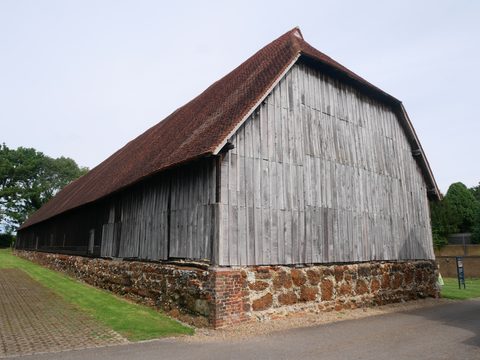
Hillingdon is an outer London borough at the western end of the Metropolitan and Piccadilly lines, and it reads as three places rather than one. Uxbridge holds a market house of 1788, a double-naved church, the inn where the commissioners of Charles I and Parliament failed to make peace in 1645, and the underground operations room from which No. 11 Group RAF fought the Battle of Britain; the Grand Union Canal and the River Colne run down the western edge through Cowley and up to Harefield. Ruislip, Eastcote and Ickenham are the Metro-land half: a barn of about 1280, a Norman motte, an 1811 canal reservoir turned lido, and an Artisan Mannerist mansion Pepys admired. Hayes, Harlington and the Heathrow villages carry Harmondsworth's Great Barn of 1426. The National Heritage List for England records 428 listed-building entries in the borough: 9 at Grade I, 30 at Grade II* and 389 at Grade II.
-
The No. 11 Group operations room of 1939, 60 ft underground down 76 steps, listed Grade I as NHLE 1392556; open seven days a week 10 to 16:30, £14.00 adult.
-
Built in 1788 on the site of a market house of 1561, listed Grade II* as NHLE 1080208, with retail stalls still trading beneath the upper hall.
-
A double-naved parish church on Windsor Street, listed Grade II* as NHLE 1180516, standing directly against the Market House.
-
The 1576 house where the Treaty of Uxbridge talks failed in 1645, listed Grade II* as NHLE 1080148; a working pub open from 12:00 seven days a week.
-
The canal reached Uxbridge on 3 November 1794; the Toll House is listed Grade II as NHLE 1358401 and the lock names a conservation area of 1975.
-
A barn of about 1280 in oak from Ruislip Woods, listed Grade II* as NHLE 1358359, on a 22-acre site with a scheduled motte and bailey moat, NHLE 1002045.
-
Consecrated in 1245 and listed Grade I as NHLE 1285697; the parish states it is open to the community seven days a week, 52 weeks a year.
-
An 1811 canal reservoir turned lido in 294 hectares of National Nature Reserve, with a 12 in gauge railway 1.02 miles long; Rover tickets £10.00 adult.
-
tip
Pepys's "very pleasant place" of 1629–38, listed Grade I as NHLE 1080295 with Grade I outbuildings, NHLE 1286571; offices, with public parkland around it.
-
3.63 hectares around Tudor stables listed Grade II as NHLE 1080226 and a dovecote of before 1593, NHLE 1285861, now The Gardens Café, open 9am to 3pm daily.
-
Unveiled 2 November 1948 to Mieczysław Lubelski's design and listed Grade II* as NHLE 1088113; it commemorates over 2,000 Polish airmen who died in RAF service.
-
Listed Grade I as NHLE 1358363, holding the tomb of Alice Spencer, Dowager Countess of Derby, buried here in January 1637.
-
The First World War plot of No. 1 Australian Auxiliary Hospital, 64 m from the church, its memorial listed Grade II as NHLE 1061377 and its archway NHLE 1061378.
-
Built 1426 by Winchester College, nearly 60 m long on 13 oak trusses, listed Grade I as NHLE 1194332; free, 2nd and 4th Sunday April to October, 11am to 4pm.
-
A Norman doorway and a turreted tower 74 m from the Great Barn, listed Grade II* as NHLE 1080201 on the same manorial site.
-
walk
144 acres straddling the Hounslow boundary around St Dunstan's Church, listed Grade II* as NHLE 1181190, and the Grade II stables, NHLE 1080157.
-
A 13th-century core with a 14th-century wall painting of St Christopher, listed Grade II* as NHLE 1080233, its lych gate Grade II, NHLE 1080234.
-
tip
Hayes's receiving house since 1977, run by Parkwood Theatres; the box office opens Monday to Friday 1:00 PM to 5:00 PM and is closed at weekends.
Uxbridge, Harefield and the Colne valley
Uxbridge is the borough town, and the Grand Union Canal and the River Colne run down the western edge from Harefield through Uxbridge to Cowley and on south. Harefield sits about 6 km upstream of Uxbridge on the same river and the same canal, and is reached by bus rather than by tube.
The Battle of Britain Bunker, on Wren Avenue, UB10 0GG, is listed Grade I as NHLE 1392556 under the register name "GROUP OPERATIONS ROOM", made on 1 December 2005. The Operations Room was built between February and August 1939 and controlled the fighter squadrons of No. 11 Group RAF, which held responsibility for the air defence of London and south-east England. Its floor is 60 ft, about 18 m, underground, reached by a staircase of 76 steps. Churchill visited on 16 August 1940, when he made the remark that became "Never in the field of human conflict...", and returned on 15 September 1940, Battle of Britain Day. RAF personnel established a museum in the bunker in 1985 and the visitor centre opened in March 2018. The operator states: "We are open seven days per week, from 10 to 16:30. Last admission 15:30." Bunker and visitor centre admission is £14.00 adult, £11.00 senior over 65, £7.00 discounted for Defence, Blue Light and students, under-16s free; visitor centre only is £8.00, £6.50 and £4.00 on the same terms. The operator states "Tours last around an hour, which includes a presentation in the plotting room." Hillingdon House, which served as No. 11 Group headquarters, stands on the same former RAF Uxbridge site and is listed Grade II, NHLE 1080115.
Two Grade II* entries stand against each other on the High Street frontage. The Market House, UB8 1JZ, was built in 1788 to replace an earlier market house of 1561 on the same site, and is listed as NHLE 1080208; its open ground floor is still in commercial use with retail stalls beneath the upper hall, and Uxbridge Underground station is 96 m away. The Church of St Margaret, on Windsor Street, UB8 1AB, is NHLE 1180516, listed on the same day in 1950. A church at Uxbridge is recorded in 1245 in a dispute brought by the Abbot of Bec; the earliest fabric to survive is part of the north tower, built in the late 14th century, and the south aisle added about 1450 produced the double-nave plan the building still has. It remained a chapel-of-ease to Hillingdon until 1827, when Uxbridge was made a parish in its own right. No source states the church's opening hours, so none are given here.
The Crown & Treaty, at 90 Oxford Road, UB8 1LU, is a working public house listed Grade II* as NHLE 1080148 under the register name "THE CROWN AND TREATY INN". It was built in 1576 as Place House for Sir John Bennett, and part of it came down when Oxford Road was widened in the 18th century for coaching traffic; the original edifice was two thirds larger than the building that survives. Commissioners for Charles I and for Parliament negotiated here between 30 January and 22 February 1645 in the failed Treaty of Uxbridge, which gives the pub its name. The original oak panelling was sold on 24 May 1930 to Louis L. Allen, a New York antiques dealer, for his Madison Avenue gallery; Armand Hammer bought it in 1945 and installed it on the 78th floor of the Empire State Building, and in 1953 gave it to Elizabeth II as a coronation present, whereupon the V&A decided to return it. Two panelled upper rooms survive restored and are licensed for civil weddings of up to 30 guests. The pub opens Monday to Thursday and Sunday 12:00–23:00, Friday and Saturday 12:00–01:00.
At Cowley, the towpath is the visit. The Grand Junction Canal, later the Grand Union, opened from the Thames at Brentford to Uxbridge on 3 November 1794, and the aqueduct carrying it over the Frays River at Cowley Lock was probably not finished until autumn 1795. Cowley Hall Dock, a 350-yard arm serving brickfields, opened in 1811, and packet boats ran to Cowley Peachey after the Paddington Arm opened on 10 July 1801. The Toll House at the lock is listed Grade II, NHLE 1358401; the canal bridge beside the Shovel Inn is Grade II, NHLE 1080184; and the Shovel Inn itself is Grade II, NHLE 1080185. Cowley Lock gives its name to one of the two conservation areas designated at Cowley in 1975, covering Old Mill Lane, Cowley Lake, the Cowley bridges and Packet Boat Lane.
Harefield, upstream, is two things in one churchyard on Church Hill, UB9 6DU. The Church of St Mary the Virgin is listed Grade I as NHLE 1358363, one of nine Grade I entries in the borough; medieval fabric survives, restored and altered in 1768 and again in 1841, and the building holds the tomb of Alice Spencer, Dowager Countess of Derby, of the Spencers of Althorp, buried here in January 1637. The Newdigate family, lords of the manor from about 1440, became patrons and are commemorated inside. The Australian military cemetery lies in the same churchyard, 64 m south-south-east of the church: Harefield Park was No. 1 Australian Auxiliary Hospital during the First World War, and Wikipedia records the plot as holding the graves of over 100 soldiers of the First Australian Imperial Force who died of wounds. The memorial is listed Grade II as NHLE 1061377 under the register name "AUSTRALIAN WAR MEMORIAL" and the entrance archway separately as NHLE 1061378, both on 19 July 2002 and 27 m apart. An Anzac Day service is held here every year, attended by Australian and New Zealand government representatives, local school children and retired servicemen.
Ruislip, Eastcote and Ickenham
This is the Metro-land half of the borough and the part with the most countryside left in it: a medieval farmyard, a Grade I parish church across the road, a canal reservoir turned lido inside a national nature reserve, and two Grade I entries in one garden at Ickenham.
Manor Farm, Bury Street, Ruislip, HA4 7SU, is a 22-acre site carrying five listed entries and a scheduled monument. The Great Barn was built about 1280 of English oak from the neighbouring Ruislip Woods and is listed Grade II* as NHLE 1358359, under the register name "GREAT BARN TO WEST OF MANOR FARM YARD". The 16th-century Little Barn, Grade II, NHLE 1192707, was converted into a library that opened on 2 November 1937 and was renovated in 2007–08. The 16th-century Manor Farmhouse, Grade II, NHLE 1080162, served as the manorial court until 1925, and two cowsheds in the farmyard are separately Grade II, NHLE 1192696 and NHLE 1080267. The moat is a scheduled monument, NHLE 1002045, which carries no grade; it is believed to have been extended to create an oval area carrying a wooden castle 350 ft by 200 ft, presumably for the landowner Ernulf de Hesdin. King's College, Cambridge, have been titular lords of the manor since 1451, the London Borough of Hillingdon runs the site, and the Duck Pond Market has been held in and around the Great Barn twice monthly since December 2008. The Cow Byre Gallery stands in the farmyard, operated by the Compass Theatre.
The Church of St Martin of Tours faces the farm across Eastcote Road, HA4 8DG, and is listed Grade I as NHLE 1285697. A church for Ruislip appears in Domesday in 1086 and is believed to have been replaced by the present building, consecrated in 1245; the chancel was built later in the 15th century by the Dean and Canons of Windsor, the tower and its bells are 15th-century, the south aisle was rebuilt in 1440 and extended in 1500, and George Gilbert Scott carried out a substantial restoration in 1870. The parish states the building is "open to the community 7 days a week, 52 weeks a year". A monument to Annie Hall in the churchyard is separately listed Grade II, NHLE 1323737, and the Ruislip Almshouses on the same street are Grade II, NHLE 1358347.
Ruislip Lido, Reservoir Road, HA4 7TY, was opened as a reservoir on 5 December 1811 by the engineer John Rennie with the constructor Hugh Mackintosh, as a feeder for the Grand Junction Canal: land at the hamlet of Park Hearne was bought and the valley dammed and flooded. It reopened as a lido in 1933 with an Art Deco building by George W. Smith, was formally opened by Earl Howe in 1936, and the canal company built the artificial sand beach on the south-east shore as part of the same scheme. Ruislip Woods around it was declared a National Nature Reserve on 21 May 1997 over 294 hectares, with an SSSI of 305.4 hectares, and is four woods — Park Wood, Mad Bess Wood and Copse Wood at Ruislip, and Bayhurst Wood at Harefield — all managed by the borough. The Ruislip Lido Railway is a 12 in (305 mm) gauge line 1.02 miles long, first built in 1945 and run since 1979 by the volunteer Ruislip Lido Railway Society, with stations at Woody Bay, Willow Lawn, Haste Hill and Eleanor's Junction; single fares are £3.50 adult and £1.80 child aged 3 to 15, returns £5.00 and £2.50, Rover tickets £10.00 and £5.00, under-3s free. The council states the car parks close at 7pm daily from 1 October to 31 March and the toilets off the Willow Lawn car park open 10am to 6pm, and records the fishing area closed after fish deaths from suspected oxygen depletion and the children's splash pad closed for repairs.
Swakeleys House, The Avenue, Ickenham, UB10 8NR, was built between 1629 and 1638 for Sir Edmund Wright, Lord Mayor of London in 1640, in the Artisan Mannerist style. It is listed Grade I as NHLE 1080295 and the outbuildings to the north carry their own Grade I entry, NHLE 1286571, so two of the borough's nine Grade I entries stand in one garden. Samuel Pepys visited twice in 1665 to collect money from Sir Robert Vyner, calling the design "the most uniforme" and the place "a very pleasant place". The Foreign & Commonwealth Office Sports Association held the house from 1927 to 1955 and the London Postal Region Sports Club from 1955; CES Properties owns it now and obtained permission in 2014 for conversion to a single house. It is in use as offices and opens in part once a year for Open House London, so there is no walk-up interior access; the surrounding Swakeleys Park is public open space.
Eastcote House Gardens, High Road, Eastcote, HA5 2FE, covers 3.63 hectares. The estate began as "Hopkyttes" in 1507 and was renamed Eastcote House when Ralph Hawtrey married Winifred Walleston in 1525; the Hawtrey family held it until 1878, Ruislip-Northwood Urban District Council bought the 9.1-acre estate in 1931 to stop its development, and the house was declared unsafe in 1962 and demolished two years later. What survives is the Tudor stable range: the Old Coach House, listed Grade II as NHLE 1080226; the dovecote built by John Hawtrey, who died in 1593, NHLE 1285861; and the garden walls to the east, NHLE 1080227, all three listed on 6 September 1974. The Heritage Lottery Fund awarded £1.3 million in 2013 towards the restoration, work finished in 2017 and the building reopened as The Gardens Café. The gardens open 9am to 4pm in January, February, November and December, 9am to 5pm in March and October, 9am to 6pm in April, 9am to 8pm from May to August and 9am to 7pm in September, with the café 9am to 3pm daily.
At South Ruislip, the Polish Air Force Memorial stands on a public roadside where West End Road meets Western Avenue, HA4 6QX, and is listed Grade II* as NHLE 1088113. It was unveiled on 2 November 1948 to the design of the Polish sculptor Mieczysław Lubelski, in Portland stone with polished granite, bronze lettering and a bronze eagle finial, and carries the insignia of the Polish fighter and bomber squadrons. It commemorates over 2,000 Polish airmen who died in RAF service: 1,243 names were inscribed at the outset, 659 more were added in the 1996 refurbishment, and 23 men killed in the Battle of France in 1940 are included. The Duke of Gloucester rededicated it in 1996 after sandstone panels were replaced in granite. Middlesex County Council, which took over and redeveloped the airfield for civilian use after the war, donated the site at the edge of RAF Northolt.
Hayes, Harlington and the Heathrow villages
The Elizabeth line and Great Western corridor runs through Hayes and Hayes & Harlington, and beyond it are the airport villages: Harmondsworth, close to the Heathrow perimeter and inside the footprint of the proposed north-west runway, and Cranford Park, which straddles the Hounslow boundary.
Harmondsworth Great Barn, at Manor Court, High Street, UB7 0AQ, is listed Grade I as NHLE 1194332. William of Wykeham bought the land in 1391 to endow Winchester College and New College, Oxford, and English Heritage give the build date as 1426 and the builder as Winchester College. The barn is nearly 60 m long, 12 m wide and 11 m tall, with 13 oak trusses carrying the roof, and John Betjeman called it "the cathedral of Middlesex". English Heritage acquired it in January 2012, publish entry as free, and open it on the 2nd and 4th Sunday of the month, April to October, 11am to 4pm; the volunteer Friends of the Great Barn at Harmondsworth run the openings. Roughly half the village would be demolished under the proposed north-west runway at Heathrow, leaving the barn close to the airport perimeter.
The Church of St Mary stands 74 m east-south-east of the barn on the same medieval manorial site held by Winchester College, on the High Street, UB7 0AG, and is listed Grade II* as NHLE 1080201. Parts of the fabric are 12th-century and the church keeps a Norman doorway and a tower with angular turrets. There is a long-running argument over whether Heathrow Airport carries chancel repair liability here, arising from land assigned at the 1819 enclosure. The village around it is densely designated: the Five Bells Inn, NHLE 1194343; Manor Farmhouse, NHLE 1358367; The Sun House, NHLE 1358366; and Harmondsworth Hall, NHLE 1080123, are all Grade II within 200 m. No source states the church's opening hours, so none are given here.
Cranford Park, off the Parkway at Hayes, UB3 4RA, covers 144 acres and opened to the public in 1949, a joint venture of Hayes & Harlington Urban District Council and Heston & Isleworth Borough Council after Cranford House was demolished following the Second World War. The park straddles the Hounslow boundary and its listed structures stand on the Hillingdon side: St Dunstan's Church, Grade II*, NHLE 1181190, thought to have been founded in the reign of Edward the Confessor; the 18th-century Cranford House stables, Grade II, NHLE 1080157; the ha-ha walls south and south-west of the stables, Grade II, NHLE 1285085; the cellars of the demolished house, Grade II, NHLE 1285115; and Cranford Park Bridge over the ha-ha in the woodland, Grade II, NHLE 1358320. The village of Cranford is mostly in Hounslow while the park is Hillingdon's. The council records a café building under construction above the historic cellars, with the toilets and information centre unavailable meanwhile.
In Hayes itself, the Church of St Mary the Virgin on Church Road, UB3 2LY, is listed Grade II* as NHLE 1080233, with the lych gate and the wall to the south a separate Grade II entry, NHLE 1080234. The centre of the building is 13th-century, the north aisle and tower 15th-century and the south aisle 16th-century, and the font is 12th-century. Medieval wall paintings survive, including a large 14th-century painting of St Christopher, and brasses commemorate Robert Lellee, rector from about 1356 to 1375, and Robert Burgeys, rector from 1408 to 1421. The former manor house stables beside the churchyard are separately Grade II, NHLE 1080274. No source states the church's opening hours, so none are given here.
The Beck Theatre, Grange Road, UB3 2UE, opened in 1977 as Hayes's receiving house and programmes touring concerts, comedy, drama, film, opera and pantomime. Parkwood Theatres operates it; the box office opens Monday to Friday 1:00 PM to 5:00 PM and the phone lines Monday to Friday 2:00 PM to 5:00 PM, both closed at weekends and on bank holidays. Barra Hall, about 345 m south-west, was Hayes's town hall from 1924 to 1979 and is listed Grade II as NHLE 1080105 under the register name "HAYES TOWN HALL".
Getting there
Hillingdon is served by four London Underground lines. The Metropolitan and Piccadilly lines share the Uxbridge branch and call together at Uxbridge, Hillingdon, Ickenham, Ruislip, Ruislip Manor and Eastcote; the Metropolitan alone serves Northwood and Northwood Hills; the Central line serves West Ruislip, its western terminus, with South Ruislip and Ruislip Gardens; and the Piccadilly line also runs to Heathrow Terminals 2 & 3 and Terminal 5. Heavy rail is Chiltern Railways on the Marylebone–Birmingham line at West Ruislip, South Ruislip, Denham and Denham Golf Club, and the Elizabeth line with Great Western Railway on the Great Western corridor at West Drayton and Hayes & Harlington, with Heathrow Express at both Heathrow stations. There is no DLR station, no tram stop and no London Overground station in the borough.
For Uxbridge, take the Metropolitan or Piccadilly line to Uxbridge: the bus station adjoins it, the nearest stop is 68 m away, and routes 222, 331, 427, A10, N207, SL8, U1, U2, U3, U4, U5, U7, U9 and U10 use it. The Market House is 96 m from the station and the Church of St Margaret stands against it. The Battle of Britain Bunker is 1,156 m from the station, with routes 427, A10, N207, U1, U3, U4, U7 and SL8 within 520 m at the stops TfL names Manor Waye / St Andrew's Park, Hillingdon Cemetery and The Greenway. Cowley Lock is 2,015 m from Uxbridge station; route 222 stops on Station Road, 222 m from the lock.
For Harefield there is no station. Denham Rail Station, on Chiltern Railways, is 2,166 m from St Mary the Virgin and Denham Golf Club 3,065 m, both over the Buckinghamshire boundary. Routes 331 and U9 stop on St Mary's Road 208 m and 215 m from the church and on Priory Avenue 361 m away; the 331 runs Uxbridge to Ruislip via Harefield and is operated by Metroline.
For Ruislip, Eastcote and Ickenham, Ruislip station is 852 m from Manor Farm and 590 m from St Martin's; West Ruislip is 1,139 m from Manor Farm on Chiltern Railways and 1,150 m on the Central line. Routes 331 and H13 stop 147 m from Manor Farm and the U10 184 m away, all three operated by Metroline. Northwood Hills, on the Metropolitan line, is 1,503 m from Ruislip Lido and route H13 stops 632 m from it. Eastcote station is 1,231 m from Eastcote House Gardens, with the 282 and H13 stopping 161 m and 186 m from the gate. Ickenham is 638 m from Swakeleys House and Hillingdon 704 m. South Ruislip has both a Central line station 988 m from the Polish Air Force Memorial and a Chiltern Railways station 994 m from it, and the 696 and E7 stop at a stop TfL names Polish Air Force Memorial, 196 m away.
For Hayes, Harlington and the Heathrow villages, take the Elizabeth line or Great Western Railway to Hayes & Harlington: 1,548 m from the Church of St Mary the Virgin, Hayes, with the 195, 278, 698 and H98 stopping on Freemans Lane 115 m from it, and 1,474 m from Cranford Park, with the 105 and H28 at Cranford Community School 632 m off and the E6 on Roseville Road 690 m off. Harmondsworth has no station within 2 km: Heathrow Terminal 5 is 2,256 m away on the Piccadilly line, with the Elizabeth line and Heathrow Express at the rail station there, and West Drayton is 2,390 m; routes 350 and U3 stop on Harmondsworth Lane 298 m from the barn. Every distance here is a straight-line measurement, not a walking one.
Frequently asked questions
- Which Underground lines serve Hillingdon?
- Four. The Metropolitan and Piccadilly lines share the Uxbridge branch and call together at Uxbridge, Hillingdon, Ickenham, Ruislip, Ruislip Manor and Eastcote; the Metropolitan alone serves Northwood and Northwood Hills; the Central line serves West Ruislip, its western terminus, with South Ruislip and Ruislip Gardens; and the Piccadilly line runs to Heathrow Terminals 2 & 3 and Terminal 5. Heavy rail is Chiltern Railways at West Ruislip, South Ruislip, Denham and Denham Golf Club, and the Elizabeth line with Great Western Railway at West Drayton and Hayes & Harlington, with Heathrow Express at both Heathrow stations. There is no DLR station, no tram stop and no London Overground station in the borough.
- When is the Battle of Britain Bunker open, and what does it cost?
- The operator states: "We are open seven days per week, from 10 to 16:30. Last admission 15:30." Bunker and visitor centre admission is £14.00 for an adult, £11.00 for a senior over 65 and £7.00 discounted for Defence, Blue Light and students, with under-16s free; the visitor centre alone is £8.00, £6.50 and £4.00 on the same terms. The operator states "Tours last around an hour, which includes a presentation in the plotting room." The bunker is on Wren Avenue, Uxbridge, UB10 0GG, listed Grade I as NHLE 1392556, and Uxbridge Underground station is 1,156 m away.
- How do I get inside Harmondsworth Great Barn?
- English Heritage open the barn on the 2nd and 4th Sunday of the month, April to October, 11am to 4pm, and publish entry as free; the volunteer Friends of the Great Barn at Harmondsworth run the openings. The barn is at Manor Court, High Street, Harmondsworth, UB7 0AQ, listed Grade I as NHLE 1194332, and is nearly 60 m long, 12 m wide and 11 m tall with 13 oak trusses. There is no station within 2 km: Heathrow Terminal 5 is 2,256 m away and West Drayton 2,390 m, and routes 350 and U3 stop on Harmondsworth Lane 298 m from the barn.
- How many listed buildings does Hillingdon hold?
- The National Heritage List for England records 428 listed-building entries inside the borough boundary as mapped by OpenStreetMap relation 183779: 9 at Grade I, 30 at Grade II* and 389 at Grade II. The nine Grade I entries are Breakspear House, NHLE 1080262; the Church of St Martin of Tours, Ruislip, NHLE 1285697; the Church of St Mary, Harefield, NHLE 1358363; the Church of St Peter and St Paul, Harlington, NHLE 1080163; the Group Operations Room at the Battle of Britain Bunker, NHLE 1392556; Ickenham Manor, NHLE 1080187; Swakeleys, NHLE 1080295, and its outbuildings, NHLE 1286571; and Harmondsworth Great Barn, NHLE 1194332. The borough also holds five scheduled monuments, which carry no grade, and two Grade II registered parks and gardens: Harefield Place, NHLE 1001525, and Stockley Park, NHLE 1466074.
- How do I reach Harefield, and what is there?
- By bus: routes 331 and U9 stop on St Mary's Road, 208 m and 215 m from the churchyard gate, and the 331 runs from Uxbridge to Ruislip via Harefield. The nearest stations are over the Buckinghamshire boundary — Denham, on Chiltern Railways, 2,166 m away, and Denham Golf Club 3,065 m. In one churchyard on Church Hill, UB9 6DU, are the Church of St Mary the Virgin, listed Grade I as NHLE 1358363 and holding the tomb of Alice Spencer, Dowager Countess of Derby, buried in January 1637; and the Australian military cemetery 64 m south-south-east of the church, whose memorial is Grade II, NHLE 1061377, and entrance archway Grade II, NHLE 1061378.
- What can I see at Ruislip in a morning?
- Manor Farm on Bury Street, HA4 7SU, holds five listed entries and a scheduled monument on one 22-acre site: the Great Barn of about 1280, Grade II*, NHLE 1358359; Manor Farmhouse, NHLE 1080162; the Little Barn, NHLE 1192707, a library since 2 November 1937; two cowsheds, NHLE 1192696 and NHLE 1080267; and the motte and bailey moat, a scheduled monument, NHLE 1002045. The Church of St Martin of Tours faces it across Eastcote Road, Grade I, NHLE 1285697, and the parish states it is "open to the community 7 days a week, 52 weeks a year". Ruislip station is 852 m from the farm and 590 m from the church, and Ruislip Lido and its 12 in gauge railway are north of both.
Connected pages
Nearby
-
Harrow, London: Harrow School, Headstone Manor, Bentley Priory, Grim's Dyke and St Lawrence Whitchurch
· Harrow, England
The Metropolitan line built both as Metro-land, Ruislip Woods and the Harrow Weald ridge are one high ground, and Northwood Hills is Hillingdon's Pinner stop.
-
Hounslow, London: Chiswick House, Syon Park, Osterley, Gunnersbury and the Kew Bridge steam museum
· Hounslow, England
The Grand Union runs from Cowley Lock down to Brentford, Heathrow sits on the Hillingdon side, and Cranford Park straddles the boundary between them.
Same region
-
Ealing, London: Pitzhanger Manor, Ealing Studios, Wharncliffe Viaduct and the Southall gurdwara
· Ealing, England
One canal, two boroughs: Cowley Lock is Hillingdon's and the Hanwell flight of locks is Ealing's, and the Grand Union is the thread that ties them together.
What travelers think
Log in to react.
No reviews yet.