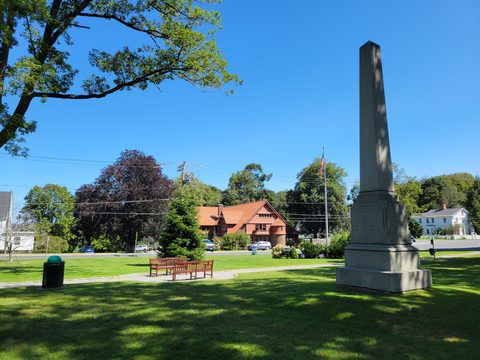

Regola, Rome: Palazzo Farnese, via Giulia and the national churches
Regola, Rome
Pictures from Regola
See all 1 photos →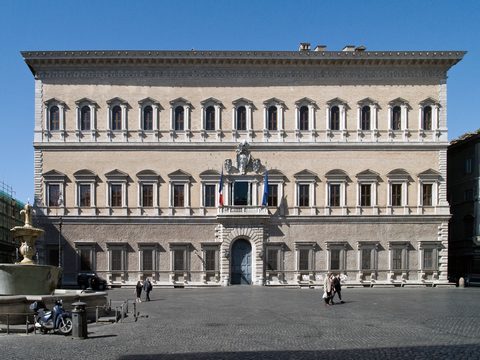
Regola is the seventh of Rome's rioni by toponymic code. Roma Capitale's own boundary list for the rione runs from vicolo della Scimia and via dei Banchi Vecchi round by Campo de' Fiori and via dei Giubbonari to piazza delle Cinque Scole and the lungoteveri along the Tiber. Inside that line stand Palazzo Farnese, Palazzo Spada with the Galleria Spada and Borromini's forced-perspective colonnade, and most of via Giulia, which Julius II opened in 1508. Regola also holds a run of national churches, one each built here by the Spanish, English, Swedish, Neapolitan, Bolognese and Sienese communities, a papal prison of 1652, a papal pawn bank, and a crypt furnished with the bones of more than eight thousand people.
-
sight
Commissioned in 1513 and finished in 1589 under Sangallo, Michelangelo, Vignola and Della Porta; entry is by guided tour booked through the palace's own site.
-
A colonnade 8.82 metres long built to read as about 35, with a 60-centimetre Roman warrior at the end that appears life-size from the entrance.
-
sight
Four rooms hung as a seventeenth-century quadreria, frames touching and small pictures above large, as Federico Zeri arranged them in 1951; last admission 19.00, closed Tuesdays.
-
walk
Opened in 1508 and running 950 metres from piazza San Vincenzo Pallotti to piazza dell'Oro; its southern length lies in Regola and its northern length in Rione V Ponte.
-
walk
The spine of the rione's northern half, running into piazza Farnese and carrying the Spanish and English churches, Palazzo Incoronati and Chez Dédé.
-
A confraternity founded in 1538 to bury bodies recovered from the Tiber; its crypt took more than 8,000 and opens only by appointment with the Associazione Amici del Tevere.
-
The goldsmiths asked Raphael in 1509 for a small temple; Roma Capitale gives access Monday to Friday 10.00 to 13.00 on prior booking.
-
sight
Innocent X's prison of 1652–1655 on via Giulia, offices towards the street and cells towards the Tiber; it held 600 men and 80 women in 1842.
-
sight
An antique mask pouring into an antique granite basin on via Giulia; Roma Capitale records that it ran wine for three days in 1720.
-
sight
Paved from 1545 and once used for tournaments, bullfights and summer floodings, with eight streets and alleys running into it.
-
A café on piazza Benedetto Cairoli, open 7.00 to 18.00 Monday to Saturday and 8.00 to 18.00 on Sunday, with a bookable indoor room.
-
food
A restaurant on the ground floor of Palazzo Cenci, on via di Santa Maria de' Calderari.
-
A guesthouse run by the Bridgettine sisters inside the Santa Brigida complex on piazza Farnese.
-
tip
Two segmental arches, 121 metres by 23; Roma Capitale states that the bridge joins the rione Regola to Trastevere.
The rione's boundary
Roma Capitale gives the rione's boundary as a list of streets rather than a line on the ground: vicolo della Scimia, via delle Carceri, via dei Banchi Vecchi, via del Pellegrino, via dei Cappellari, Campo de' Fiori, via dei Giubbonari, via di Santa Maria del Pianto, piazza delle Cinque Scole, via del Progresso, lungotevere de' Cenci, lungotevere dei Vallati and lungotevere dei Tebaldi. A street named as a limit is evidence of a line, not of what stands on either side of it, so a building addressed on one of them can belong to either neighbour.
Roma Capitale states that Santi Biagio e Carlo ai Catinari was once inside the perimeter of rione Regola but today belongs to rione Sant'Eustachio. Sources disagree about which rione piazza delle Cinque Scole and the Della Porta fountain standing in it belong to. Roma Capitale's boundary description of Rione VII names via dei Giubbonari among the rione's limits and describes it as a shopping street; Salumeria Roscioli stands on it at no. 21.
Via Giulia was opened in 1508 and runs 950 metres from piazza San Vincenzo Pallotti to piazza dell'Oro. Its southern length lies in Regola; its northern length lies in Rione V Ponte. Palazzo Sacchetti, the Oratorio del Gonfalone and the Museo Criminologico stand in Ponte.
Getting there
No source states a metro station or a bus route for Regola, so none is given here, and neither are walking times or any distance this guide has not taken from a source. Steer by addresses instead.
The anchors first. Palazzo Farnese and the École française de Rome share Piazza Farnese 67; the palace's guided visits are sold only through visite-palazzofarnese.it. Palazzo Spada, the Galleria Spada and Borromini's colonnade are all at Piazza Capo di Ferro 13. Santa Brigida and the Bridgettines' guesthouse are at Piazza Farnese 96. The Fontana del Mascherone stands on via Giulia, and Roma Capitale's file on it names the rione outright.
Via di Monserrato is the spine of the northern half of the rione, and the addresses on it do most of the navigating: Palazzo Incoronati at 152, Santa Maria in Monserrato degli Spagnoli at 115, San Girolamo della Carità at 62/A in Roma Capitale's numbering, San Tommaso di Canterbury and the Venerabile Collegio Inglese at 45, Chez Dédé at 35. On via Giulia, count off Palazzo Falconieri at 1, Off/Off Theatre at 19, Spirito Santo dei Napoletani at 34, the Collegio Ghislieri façade inside the Liceo Virgilio at 38, the Carceri Nuove at 52, the D.O.M Hotel at 131, San Filippo Neri at 134/B, Palazzo Ricci's second front at 146, Palazzo Cisterna at 163 and Santa Maria dell'Orazione e Morte at 262.
One trap defeats map software as well as visitors. Via Giulia, via dei Giubbonari, via dei Banchi Vecchi, via del Pellegrino and via di Santa Maria del Pianto are all shared with a neighbouring rione along part of their length, so an address on any of them is an address and not a statement about which rione a building stands in. The streets and rises that lie inside the rione, and that this guide uses for orientation, are via di Monserrato, via del Mascherone, via dei Pettinari, via di San Paolo alla Regola, via degli Specchi, via Arenula and Monte de' Cenci.
Tickets, bookings and locked doors
Regola asks for more advance planning than most of central Rome, because several of its best interiors open only by arrangement.
Palazzo Farnese is entered on a guided tour and no other way. The tours run in Italian, French or English; tickets are sold only through the palace's official visits site, from 90 days ahead until 5 days before, a maximum of 8 per transaction, personal, non-refundable and non-transferable unless the flexible ticket is bought. The published slots are: Palazzo Farnese on Monday at 15.00, 16.00 and 17.00 and on Tuesday, Thursday and Friday at 15.00 and 16.00; Palazzo Farnese with the Sotterranei on Monday at 17.00 in Italian, Tuesday at 17.00 in English and Thursday at 17.00 in French; Palazzo Farnese with the École française de Rome on Friday at 17.00. Prices are 15 euro for the palace, 20 euro with the Sotterranei and 22 euro with the École française, free for children up to 6. Visitors present themselves 30 minutes before the slot with the original of the same identity document used at purchase; identity card or passport only, driving licences and photocopies not accepted. There is no cloakroom, and trolleys, luggage and backpacks may not be brought in, though women's handbags may. No photography inside. Groups are a maximum of 33, and 25 for the Tuesday, Thursday and Friday 17.00 visits. The palace is accessible to visitors with disabilities except for the École française de Rome and the Sotterranei, and the Sotterranei are not open to children under 12 or to visitors with motor disabilities.
For the Galleria Spada, Roma Capitale gives last admission at 19.00, closure on Tuesdays, on 25 December and on 1 January except for special openings under MiC programmes, and guided visits to the palace's Piano Nobile, the Sale del Consiglio di Stato, on the first Saturday of the month with booking required. No source states the gallery's opening time, so none is given here. Tickets are sold online at www.tosc.it/artist/galleria-spada; the gallery's phone is 06 6874896 and bookings go through 06 32810.
Three more doors need a telephone. Sant'Eligio degli Orefici opens Monday to Friday from 10.00 to 13.00 on prior booking on 06 6868260. The crypt of Santa Maria dell'Orazione e Morte, which holds the bones of more than 8,000 people, is open only by appointment with the Associazione Amici del Tevere, on 339 5852777 or 339 7448084. Visits to San Girolamo della Carità are arranged by telephoning 349 5880020. The Stanze di Santa Brigida above the church can still be visited, in Roma Capitale's words, with access arranged through the community. Two things in the rione cannot be entered at all: San Filippo Neri in via Giulia is deconsecrated and is not open to visitors, and the Scuderie di Augusto have been reburied to preserve them.
Frequently asked questions
- Can you go inside Palazzo Farnese?
- Yes, but only on a guided tour booked in advance through the palace's official visits site, in Italian, French or English. Tickets go on sale 90 days ahead and close 5 days before; you arrive 30 minutes early with the same passport or identity card you booked with, and driving licences are not accepted. The palace has housed the Embassy of France since 1874 and, from the following year, the École française de Rome. The Sotterranei, opened to the public on 29 May 2024, are a separate ticket and are not open to children under 12.
- What is the Borromini perspective, and where is it?
- It is a colonnade in the courtyard of Palazzo Spada at Piazza Capo di Ferro 13, reached at the end of the first-floor museum route through the Giardino Segreto. Borromini built it in a single year, between 1652 and 1653, assisted by the Augustinian Giovanni Maria da Bitonto, replacing a painted perspective by Giovanni Battista Magni. The colonnade is 8.82 metres long and is built to read as about 35 metres: the mosaic floor rises, the ceiling drops, and the planes converge on a single vanishing point. The cast of a Roman warrior standing at the colonnade's end is 60 centimetres high and was placed there in 1861 by Prince Clemente Spada; from the entrance it appears life-size.
- Is the Venerabile Collegio Inglese part of the Vatican?
- No. The college stands at via di Monserrato 45, on Italian soil in rione Regola, and a visitor there is under Italian law. It is a pontifical institution, which is not the same thing as a property named in the Lateran Treaty, and it appears in neither of the Treaty's lists. The same is true of Santa Maria in Monserrato degli Spagnoli and San Tommaso di Canterbury on the same street. Nothing in Regola is inside Vatican City.
- Which churches in Regola can actually be entered?
- Santissima Trinità dei Pellegrini keeps the fullest published schedule: Roma Capitale gives Mass Monday to Saturday and on days before feasts at 07.15 and 18.30, and on Sundays and days of obligation at 09.00, at 11.00 as a solemn Mass said as a low Mass in August, and at 18.30, noting that times may change and asking visitors to contact the church on 06 68300486. Santi Giovanni Evangelista e Petronio dei Bolognesi says Mass Monday to Friday at 19.00 and opens an hour before. Sant'Eligio degli Orefici opens Monday to Friday 10.00 to 13.00 on prior booking. San Girolamo della Carità and the crypt of Santa Maria dell'Orazione e Morte are arranged by telephone. For the rest, no source states opening hours, so none are given here.
- Is Campo de' Fiori in Regola?
- No. Campo de' Fiori is named in Roma Capitale's boundary list as one of the rione's limits, which makes it a boundary of Regola rather than part of it. On Regola's side of that seam stand the Locanda del Gallo, the fifteenth-century property of Vannozza Cattanei whose family arms are still on the vicolo del Gallo front, and the run of palaces along via dei Cappellari and the Monte di Pietà.
- What is there to see in Regola without a ticket?
- Piazza Farnese, paved from 1545, with its two fountains: Roman granite basins moved from piazza San Marco, turned into fountains by Girolamo Rainaldi in 1626, each with a travertine outer basin, an amphora-shaped baluster, a Farnese lily and seven jets. The Fontana del Mascherone on via Giulia, whose antique mask pours the water into a granite thermal basin. The painted front of Palazzo Ricci on piazza de' Ricci, which Roma Capitale attributes to Polidoro da Caravaggio about 1525 with Maturino da Firenze. The façades of Santa Maria dell'Orazione e Morte, with its winged skeleton and the words Hodie mihi, cras tibi, and of Santa Caterina da Siena, where Romulus, Remus and the she-wolf stand for Siena. And Ponte Garibaldi, which Roma Capitale says joins Regola to Trastevere.
Connected pages
Nearby
-
Ponte, Rome: the bridge the rione is named for, Palazzo Altemps and via dei Coronari
· Ponte, Rome
Via Giulia's northern length lies in Rione V Ponte, which holds Palazzo Sacchetti, the Oratorio del Gonfalone and the Museo Criminologico.
-
Parione, Rome: Piazza Navona, Campo de' Fiori and the Cancelleria
· Parione, Rome
Campo de' Fiori, the Giordano Bruno monument and the Arco degli Acetari are Parione's; Roma Capitale names Campo de' Fiori among Regola's limits.
-
Trastevere (R. XIII), Rome: Fountains, the Janiculum and 1849
· Trastevere, Rome
Across the Tiber. Roma Capitale states that Ponte Garibaldi joins the rione Regola to Trastevere.
-
Sant'Angelo, Rome: the Portico d'Ottavia, the Teatro di Marcello and the old Jewish quarter
· Sant'Angelo, Rome
The neighbour across piazza delle Cinque Scole and via di Santa Maria del Pianto, holding Palazzo Cenci and several restaurants people call the Ghetto's.
-
Sant'Eustachio, Rome: Borromini's Sant'Ivo, the Caravaggios of San Luigi dei Francesi and the Senate's palaces
· Sant'Eustachio, Rome
The neighbour across via Arenula and piazza Benedetto Cairoli, which holds the square that San Carlo ai Catinari is addressed on.
Same region
-
Pigna, Rome: the Pantheon, the Largo Argentina temples and the Jesuit quarter
· Pigna, Rome
Another rione in this series, east across the historic centre: the Pantheon, the Largo Argentina temples and the Jesuit quarter.
See also
-
3 Days in Rome: Colosseum Arena Floor, the Vatican, and the Back Streets of Monti
· Rome, Italy
The three-day Rome itinerary in this series. Palazzo Farnese and the Borromini perspective both stand inside this rione.
What travelers think
Log in to react.
No reviews yet.