
Sant'Angelo, Rome: the Portico d'Ottavia, the Teatro di Marcello and the old Jewish quarter
Sant'Angelo, Rome
Pictures from Sant'Angelo
See all 1 photos →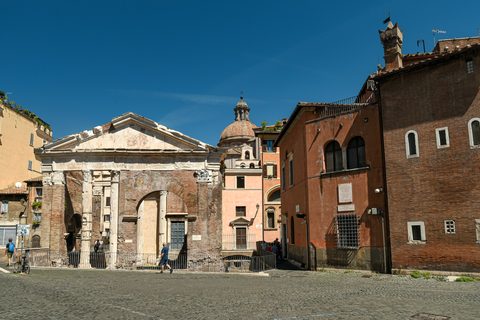
Sant'Angelo is R. XI, the eleventh of Rome's rioni by toponymic code, and it measures about 480 metres by 360 metres, roughly a tenth of a square kilometre. Inside that you can stand in front of the Portico d'Ottavia, the Teatro di Marcello with a Renaissance palace built on top of it, the Fontana delle Tartarughe and the Great Synagogue of Rome, and walk between them in a handful of streets. The rione holds the old Jewish quarter, enclosed by papal bull in 1555 and demolished in 1885, and the two museums that carry its history. It also holds ten churches, a whole block of Mattei family palaces, and a national museum that has been shut since January 2023. Almost every edge of the rione runs down the middle of a street or a square shared with a neighbour.
-
sight
Augustus rebuilt it between 27 and 23 BC and dedicated it in his sister's name; Septimius Severus and Caracalla rebuilt most of what stands, in 203.
-
sight
Begun by Julius Caesar and dedicated in 13 or 11 BC in the name of Augustus's nephew; the Sovrintendenza Capitolina gives it as free, open daily, and seen from the outside only.
-
sight
The Great Synagogue, built between 1901 and 1904 to Osvaldo Armanni and Vincenzo Costa's winning design, with a square-based dome clad in aluminium.
-
sight
Seven rooms of textiles, inscriptions and the treasures of the Cinque Scole; the ticket includes a guided visit to the synagogue, and the museum is closed on Saturdays.
-
The Fondazione gives its museum at via del Portico d'Ottavia 29, open Sunday to Thursday 10.00 to 18.00 and Friday 10.00 to 13.00, closed Saturday.
-
The quarter enclosed by the bull Cum nimis absurdum on 14 July 1555, its wall pulled down on Pius IX's order in 1847 and the quarter itself demolished in 1885.
-
sight
The square where 1,259 people were arrested on 16 October 1943; the plaque records 2,091 Roman Jews deported over the whole occupation, of whom 101 returned.
-
sight
Della Porta's design of 1581 to 1588 with Taddeo Landini's bronzes; the turtles were added in 1658 to 1659 and the ones in place now are copies.
-
The church built into the propylaeum of the Portico d'Ottavia, from which Cola di Rienzo set out on Whit Sunday 1347 to seize the Capitol.
-
Three Republican temples are embedded in its walls and crypt; the campanile is a converted Pierleoni tower and one bell was commissioned by Pandolfo Savelli in 1289.
-
walk
A whole block the Mattei built between the 15th and 17th centuries over the remains of the theatre of Balbus, holding four of their palaces.
-
Roma Capitale states it has been closed to the public since 9 January 2023 for works connected with the URBS project, with no reopening date given.
-
Roma Capitale records Luigi Ceccarelli founding the osteria with his wife Ines in 1923, and gives the hours as Tuesday to Sunday, closed Monday.
-
food
The bakery Roma Capitale names on its page for the rione, for its torta di visciole e ricotta, a sour cherry and ricotta tart.
What is in Sant'Angelo, and what is not
Sant'Angelo has six land borders and every one of them runs along a named street or square. Roma Capitale's page for the rione gives the boundary as largo Arenula, via Florida, via delle Botteghe Oscure, via dell'Aracoeli, via and piazza Margana, via dei Delfini, via dei Cavalletti, via della Tribuna di Campitelli, via del Teatro di Marcello, via del Foro Olitorio, lungotevere de' Cenci, via del Progresso, piazza delle Cinque Scole, via di Santa Maria del Pianto, via in Publicolis and via di Sant'Elena. it.wikipedia's article on the rione gives a list that agrees in most of its length and adds via di Monte Savello, via Montanara and via dei Falegnami. A street named as a boundary tells you where the line runs, not what stands on either side of it.
The Isola Tiberina, ponte Fabricio and ponte Cestio are in Ripa. Palazzo Cenci, the Cenci streets and Santa Maria del Pianto are in Regola. Largo di Torre Argentina with its four Republican temples is in Pigna, and the archaeological area under via delle Botteghe Oscure, directly across the street from the Crypta Balbi, is in Pigna too: the Sovrintendenza Capitolina's own page for it gives Rione Pigna. Piazza Margana, the Capitoline hill and the museums on it are in Campitelli.
The restaurants people mean when they say the Ghetto's restaurants do not all sit in one rione. Piperno, Sora Margherita, Al Pompiere, Beppe e i suoi formaggi and Sheva stand across the line in Regola. Giggetto, Nonna Betta, Ba'Ghetto, BellaCarne, La Taverna del Ghetto, Renato al Ghetto and the Boccione bakery are in Sant'Angelo.
One name is worth explaining before you look for it on a map. Santa Maria in Portico in Campitelli stands on piazza di Campitelli, and both the church and the square are in Sant'Angelo. it.wikipedia records that the building belonged originally to rione Campitelli and was attributed to Sant'Angelo when Sant'Angelo's boundaries were extended around the middle of the twentieth century.
Getting there
No source states a metro station or a bus route for the rione, so none is given here, and neither are walking times or distances. Steer by addresses.
The Museo Ebraico di Roma gives its address as via Catalana, in the Tempio Maggiore complex. The Fondazione Museo della Shoah ETS gives the Casina dei Vallati at via del Portico d'Ottavia 29. Roma Capitale gives the Museo Nazionale Romano Crypta Balbi at via delle Botteghe Oscure 31. The parish of Santa Maria in Portico in Campitelli is at piazza di Campitelli 9. The Sovrintendenza Capitolina gives its own seat as piazza Lovatelli 35, and lists the Centro di Documentazione dell'Appia at via del Teatro di Marcello 5. Sala Santa Rita is at via Montanara 8, and Trattoria Giggetto at via del Portico d'Ottavia 21/A.
Several of those streets are rione boundaries: via delle Botteghe Oscure, via del Teatro di Marcello, via Montanara and piazza delle Cinque Scole all have another rione on the far side. An address on one of them is an address and nothing more. The streets that lie inside Sant'Angelo, and that this guide uses to orient rather than as records, are via del Portico d'Ottavia, via della Reginella, via Catalana, via del Tempio, via di Sant'Ambrogio, via di Sant'Angelo in Pescheria and via del Foro Piscario.
Tickets and opening hours
The Sovrintendenza Capitolina gives the Teatro di Marcello as open every day, 9.00 to 19.00 under summer time and 9.00 to 18.00 under winter time, entry free, closed on 1 May, and states that it is seen from the outside only. Roma Capitale gives the Portico d'Ottavia as always visitable, reached by a ramp and a cordonata.
The Museo Ebraico di Roma publishes its 2026 hours in bands. In winter: 1 to 26 October, Sunday to Thursday 10.00 to 17.00, last admission 16.15, and Friday 9.00 to 14.00, last admission 13.15; 27 October to 9 November and 12 January to 8 February, Sunday to Thursday 10.00 to 16.30, last admission 15.45, and Friday 9.00 to 14.00; 10 November to 11 January, Sunday to Thursday 10.00 to 16.00, last admission 15.15, and Friday 9.00 to 14.00; 9 February to 31 March, Sunday to Thursday 10.00 to 17.00 and Friday 9.00 to 14.00. In summer, 1 April to 30 September, Sunday to Thursday 10.00 to 18.00, last admission 17.15, and Friday 10.00 to 16.00, last admission 15.15. It is closed on Saturdays and on Jewish holidays, and the museum publishes a dated closure calendar. Admission is 12.00 euro full, 6.00 euro for students up to 25 with proof and 10.00 euro on the agreement rate, free for children under 10, for visitors with certified disability above 74 per cent and a companion where needed, for ICOM and ICOMOS card holders, for police and armed forces and for accredited journalists; online transactions carry a 1.00 euro service commission. The ticket includes a guided visit to the Tempio Maggiore. Guided tours of the museum with the Tempio Maggiore and the Tempio Spagnolo are 100.00 euro for families and adult groups up to 25, plus admission; walking tours of the Jewish quarter are 100.00 euro for one to four people, 150.00 euro for five to fifteen and 10.00 euro a head for sixteen to thirty-five. Booking is online and at least five days ahead.
The Fondazione Museo della Shoah ETS gives the Casina dei Vallati as open Sunday to Thursday 10.00 to 18.00 and Friday 10.00 to 13.00, excluding Jewish holidays, closed Saturday.
Roma Capitale states that from 9 January 2023 the Crypta Balbi has been closed to the public for the works connected with the URBS project. No reopening date is stated.
For the churches, the parish of Santa Maria in Portico in Campitelli gives Mass at 10.00 and 18.30 on feast days and 7.30 and 18.30 on weekdays. No source states opening hours for Sant'Angelo in Pescheria, San Nicola in Carcere or Santa Caterina dei Funari, so none are given here. Roma Capitale gives Sala Santa Rita as open when an exhibition is running. Among the restaurants, Roma Capitale gives Trattoria Giggetto as Tuesday to Sunday 12.30 to 15.00 and 19.30 to 23.00, closed Monday, and Nonna Betta's own site gives 12.15 to 15.00 and 18.30 to 22.00, closed Tuesday.
Frequently asked questions
- Is all of the Roman Ghetto in Sant'Angelo?
- No. Roma Capitale describes the old Jewish quarter as situated inside Rione XI - Sant'Angelo, and the Portico d'Ottavia, the Tempio Maggiore, the Museo Ebraico, the Museo della Shoah at the Casina dei Vallati and via della Reginella are all here. But the rione boundary with Regola runs along piazza delle Cinque Scole, via di Santa Maria del Pianto and via del Progresso, and several of the restaurants a visitor would name as the Ghetto's stand on the far side of it: Piperno, Sora Margherita, Al Pompiere, Beppe e i suoi formaggi and Sheva are in Regola, as are Palazzo Cenci and the Cenci streets.
- Can you go inside the Great Synagogue?
- Yes, through the Museo Ebraico di Roma. The museum states that its ticket includes a guided visit to the Tempio Maggiore, and it also runs longer guided tours that take in the Tempio Spagnolo, the Spanish-rite oratory placed in the same building in 1932. Admission is 12.00 euro full and 6.00 euro for students up to 25 with proof. The museum is closed on Saturdays and on Jewish holidays and publishes a dated closure calendar; on Fridays it shuts early, at 14.00 for most of the year and 16.00 between 1 April and 30 September.
- Is the Crypta Balbi open?
- No. Roma Capitale states that from 9 January 2023 the Crypta Balbi has been closed to the public for the works connected with the URBS project, and no reopening date is stated. It is one of the four seats of the Museo Nazionale Romano, with Palazzo Massimo, Palazzo Altemps and the Terme di Diocleziano, and it stands at via delle Botteghe Oscure 31, over the porticoed courtyard behind the theatre Lucius Cornelius Balbus dedicated in 13 BC.
- Why is Santa Maria in Portico in Campitelli not in Campitelli?
- Because the boundary moved. it.wikipedia records that the church belonged originally to rione Campitelli and was attributed to rione Sant'Angelo when Sant'Angelo's boundaries were extended around the middle of the twentieth century, after the clearances of the Fascist period. The name it carries is older than the line. The square it stands on, piazza di Campitelli, is in Sant'Angelo too, together with the Palazzetto di Flaminio Ponzio at no. 6 and Palazzo Clementi.
- What is largo 16 Ottobre 1943?
- A square in the Jewish quarter named for the round-up carried out there. Between 5.30 in the morning and two in the afternoon on 16 October 1943, SS and German order police, working from a census taken years earlier by the Fascist government, arrested 1,259 people in the square and the surrounding streets. Weeks earlier the community had been made to hand over fifty kilograms of gold against a promise of safety, and had done so. After foreign nationals and members of mixed families were released, 1,023 people were deported to Auschwitz; sixteen came back. The plaque in the square records 2,091 Roman Jews deported over the whole of the German occupation, of whom 101 returned.
- What can you actually get into in Sant'Angelo?
- Two ticketed institutions with published hours: the Museo Ebraico di Roma, whose ticket includes the Tempio Maggiore, and the Fondazione Museo della Shoah at the Casina dei Vallati. The Teatro di Marcello is free and open daily, seen from the outside only, and the Portico d'Ottavia is given by Roma Capitale as always visitable. Sala Santa Rita, the deconsecrated church that Roma Capitale runs as an exhibition space, opens when an exhibition is on. The Crypta Balbi is closed. The churches keep their own arrangements; the parish of Santa Maria in Portico in Campitelli publishes Mass times, which are not visiting hours.
Connected pages
Nearby
-
Campitelli, Rome: the Capitoline, the Roman Forum and the Palatine
· Campitelli, Rome
The neighbour along via dell'Aracoeli, piazza Margana and via dei Delfini, holding the Capitoline hill and its museums.
-
Pigna, Rome: the Pantheon, the Largo Argentina temples and the Jesuit quarter
· Pigna, Rome
The neighbour across via delle Botteghe Oscure and via Florida. The Area Sacra di Largo Argentina and its four temples are there, not here.
-
Regola, Rome: Palazzo Farnese, via Giulia and the national churches
· Regola, Rome
The neighbour across piazza delle Cinque Scole and via di Santa Maria del Pianto, holding Palazzo Cenci and several restaurants people call the Ghetto's.
-
Ripa, Rome: the Forum Boarium, the Circus Maximus, the Aventine and the Tiber island
· Ripa, Rome
The neighbour beyond via del Foro Olitorio and via di Monte Savello, holding the Isola Tiberina and the Circus Maximus.
-
Sant'Eustachio, Rome: Borromini's Sant'Ivo, the Caravaggios of San Luigi dei Francesi and the Senate's palaces
· Sant'Eustachio, Rome
The neighbour across largo Arenula and via in Publicolis, which holds the church of Santa Maria in Publicolis.
See also
-
3 Days in Rome: Colosseum Arena Floor, the Vatican, and the Back Streets of Monti
· Rome, Italy
The three-day Rome itinerary in this series. Sant'Angelo is small enough to cross on foot between two of its stops.
What travelers think
Log in to react.
No reviews yet.