
Trastevere (R. XIII), Rome: Fountains, the Janiculum and 1849
Trastevere, Rome
Pictures from Trastevere
See all 1 photos →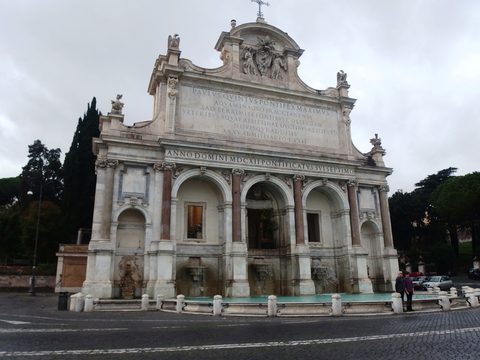
Trastevere is the thirteenth rione of Rome, R. XIII, on the right bank of the Tiber. it.wikipedia derives the name from the Latin trans Tiberim, beyond the Tiber, and states that the present rione corresponded to the fourteenth of the regions into which Augustus divided the territory of Rome, called Regio Transtiberim. it.wikipedia records that water arrived in 1612, when Paul V's Acqua Paola aqueduct reached the quarter; five of the fountains it fed have their own record in Roma Capitale's voice. Above the flat streets the Janiculum ridge carries the promenade, the ossuary and the monuments of the Roman Republic of 1849. This guide covers buildings, water and the Risorgimento. The trattorie, bakeries, cinemas and the Porta Portese flea market are not here, because no source for them could be fetched.
-
Tradition founds it under Callistus I (217-222) and has it completed under Julius I (337-352), with a renewal in the twelfth century under Innocent II.
-
It appears on Pietro il Massaio's plan of 1471, was reworked by Bernini under Alexander VII, and was rebuilt by the Comune in 1873 to Carlo Fontana's model of 1692.
-
A late-Palaeochristian structure, apse and narthex stand behind the Baroque interior, with Ferdinando Fuga's forebuilding and courtyard in front.
-
A Renaissance rectory church of the Friars Minor, badly damaged in the siege of Rome of 1849, the fighting that ran along this ridge.
-
A small circular High Renaissance building attributed to Bramante, standing in a cloister of the convent beside the church.
-
Built in 1610-1614 for Paul V by Giovanni Fontana with Flaminio Ponzio, using marbles from the Roman Forum and granite columns from the Constantinian St Peter's; the front is always accessible, the garden behind only by booking on 060608.
-
Two plane-lined avenues laid out from October 1883 and finished in 1896 on the ground of the 1849 defence, now carrying eighty-four busts of Garibaldians.
-
Thirty-six loculi carry slabs naming more than 1,600 of the fallen of 1849-1870, and the porphyry sarcophagus holds Goffredo Mameli; open Tuesday to Saturday 09:30-13:30, with a free guided visit every Saturday at 11:00.
-
Emilio Gallori's equestrian statue, begun 1886 and inaugurated on 20 September 1895, stands on the site of the Corsini casino at the top of the Passeggiata.
-
Since 1904 a howitzer has been fired with a blank charge at exactly noon each day below the Janiculum Belvedere, a signal Pius IX instituted to stop confusion over the hour.
-
Housed in Porta San Pancrazio, its route covers the Roman Republic through documents, artworks and multimedia, and entry is free.
-
sight
Agostino Chigi commissioned Baldassarre Peruzzi in May 1505 and moved in in 1511; Raphael, Sebastiano del Piombo and Sodoma painted the rooms, open to the public as a museum since 2009.
-
Its subject is Roman popular life of the late eighteenth and nineteenth centuries as the artists and folklorists of the day represented it; information and booking on 060608, 09:00-19:00.
-
walk
Sixtus IV built it for the Jubilee of 1475 to link the rione directly to the rest of the city, when only the Tiber Island bridges and Ponte Sant'Angelo were working; a restoration completed in 1998 removed the nineteenth-century metal walkways.
What the rione is, and where its edges run
it.wikipedia records Trastevere as R. XIII and states its boundaries: the Mura gianicolensi to the south and west, the Principe Amedeo Savoia-Aosta tunnel to the north, and the Tiber to the east. Its neighbours are Borgo to the north; Ponte, Regola, Ripa and Testaccio to the east across the river; and Aurelio, Gianicolense and Portuense to the west and south. Sixtus V fixed the fourteen historic rioni in 1586, Trastevere being the thirteenth, and Benedict XIV's revision of 1744 gave the rione the boundaries it has now. Water reached it in 1612 through the Acqua Paola aqueduct under Paul V, which reused the ancient Trajanic aqueduct. Urban VIII raised the Mura gianicolensi in 1643 on a different line from the Aurelian Walls, which were demolished on the Janiculum; the new walls took in via della Lungara and moved Porta Portese. The rione's arms are a gold lion's head on a red field, which it.wikipedia gives citing Carlo Pietrangeli. it.wikipedia also states that the toponym denotes zona urbanistica 1B of Municipio Roma I; Roma Capitale states that its toponymic areas «non hanno alcuna relazione con le aree urbanistiche né amministrative», so the two are distinct designations that share a name. OpenStreetMap and it.wikipedia give different population figures and the Trastevere article itself gives none.
Squares, water and the Janiculum
The rione has two kinds of square, and it.wikipedia separates them: piazza Mastai, piazza San Cosimato and piazza Sidney Sonnino were opened in the nineteenth century, while piazza di Santa Maria in Trastevere, piazza Trilussa, piazza di Sant'Egidio and piazza della Scala are of the older, intimate type. Four of the five fountains Roma Capitale documents here stand on squares, and each is a different century: the fountain in piazza di Santa Maria in Trastevere is on Pietro il Massaio's plan of 1471 and was rebuilt in 1873 to Carlo Fontana's model of 1692; the wall fountain in piazza Trilussa was built in 1613 for the left bank and rebuilt on this one in 1898; the fountain in piazza Mastai was built in 1865 for Pius IX's new quarter; and the Fontana del Prigione, made in 1587-1590 for a garden on the Esquiline, was moved here in 1923. The fifth is the Mostra dell'Acqua Paola, the terminal display of the aqueduct, high on the Janiculum above them all. The ridge itself is Risorgimento ground: Roma Capitale records that the last defence of the Roman Republic was fought on the Colle del Pino from 30 April to early July 1849, that the State and the Comune bought the ground in 1883 and made it a promenade dedicated to the memory of that defence, and that eighty-four busts of Garibaldians now line its avenues. The Mausoleo Ossario Garibaldino holds the remains of the fallen of 1849-1870 and the sarcophagus of Goffredo Mameli; the museum of the Roman Republic is in Porta San Pancrazio, per it.wikipedia; and Roma Capitale states that since 1904 a howitzer has been fired with a blank charge at exactly noon each day below the Janiculum Belvedere.
Getting there
Trastevere's whole eastern edge is the river, so every bridge to the left bank crosses a rione line by construction. This corpus records Ponte Sisto and Ponte Giuseppe Mazzini under Trastevere, where their centroids fall, and records Ponte Garibaldi under Regola, Ponte Cestio and Ponte Palatino under Ripa, Ponte Sublicio under Testaccio, and the Isola Tiberina under Ripa. it.wikipedia's account of the boundary names the riverside roads in order: lungotevere Gianicolense as far as ponte Mazzini, lungotevere della Farnesina as far as ponte Sisto, lungotevere Raffaello Sanzio as far as ponte Garibaldi, lungotevere degli Anguillara as far as ponte Cestio, lungotevere degli Alberteschi as far as ponte Palatino, and lungotevere Ripa as far as ponte Sublicio. Do not plan around the railway station that carries the name: it.wikipedia states of Roma Trastevere that «benché, nonostante il nome, sorga al di fuori di esso» - despite the name, it stands outside the rione - and places it in piazza Flavio Biondo, behind the rione, in the area of the quartiere Portuense. On the hill, Roma Capitale gives the entrances to the Passeggiata del Gianicolo as via Garibaldi and the salita di Sant'Onofrio, and the entrances to Villa Sciarra as via Calandrelli, via Dandolo and via delle Mura Gianicolensi. The garden behind the Mostra dell'Acqua Paola is reached by a stair at via Garibaldi 30 and must be booked in advance on 060608 between 09:00 and 19:00.
Frequently asked questions
- Is the Vatican in Trastevere?
- No. Vatican City is a sovereign state and belongs to no rione, so St Peter's Basilica, St Peter's Square, the Vatican Museums and the Sistine Chapel appear in no rione guide in this corpus. Trastevere's northern neighbour is the rione Borgo. What Trastevere does hold is a property of the third legal tier, the Palazzo di San Callisto: Under the Lateran Treaty of 11 February 1929, Italy recognises the Holy See's full ownership of this property (Art. 13; Annex II). Art. 15 states that the property, «benché facenti parte del territorio dello Stato italiano» — although forming part of the territory of the Italian State — enjoys the immunities that international law grants to the headquarters of the diplomatic agents of foreign States. It is on Italian soil and visitors are subject to Italian law.
- Is Roma Trastevere railway station in Trastevere?
- No, and it.wikipedia says so in terms: «benché, nonostante il nome, sorga al di fuori di esso» - despite the name, it stands outside the rione. The station's own article places it in piazza Flavio Biondo, behind the rione, in the area of the quartiere Portuense.
- Is Trastevere part of a UNESCO World Heritage site?
- This guide does not say so, because the record does not. UNESCO's World Heritage List records the Historic Centre of Rome, the Properties of the Holy See in that City Enjoying Extraterritorial Rights and San Paolo Fuori le Mura with a date of inscription of 1980, a significant modification to the boundaries in 1990, minor boundary modifications in 2015 and 2023, criteria (i)(ii)(iii)(iv)(vi), a property area of 1,469.7 hectares and a buffer zone of 7,158.933 hectares, and describes the site as extended in 1990 to the walls of Urban VIII. That record names no rione at all, and this guide does not draw the inference for it.
- Which Tiber bridges count as Trastevere's?
- Ponte Sisto and Ponte Giuseppe Mazzini, on the evidence of where their centroids fall. Ponte Garibaldi is recorded under Regola, Ponte Cestio and Ponte Palatino under Ripa, Ponte Sublicio under Testaccio, and the Isola Tiberina under Ripa. The Belli monument, which stands in the Trastevere piazza facing Ponte Garibaldi, is Trastevere's: the monument is in the rione even where the bridge in front of it is not.
- Can I get into the garden behind the Fontanone?
- Roma Capitale states that the front of the fountain is always accessible; that the small garden behind it, reached by a stair at via Garibaldi 30, is open only to accompanied groups of up to 25, and to individual visitors on a published calendar, in both cases by prior booking on 060608 between 09:00 and 19:00; and that admission is EUR 4.00 full, EUR 3.00 reduced, and free for residents of Rome and the metropolitan area on production of proof of residence and for MIC cardholders.
- Why is there no trattoria, bakery or Porta Portese market in this guide?
- Because nothing about them could be sourced. The research for this wave gathered no address, no hours and no fetched fact for the bakeries, pastry shops, market stalls or cinemas of the rione, and the Porta Portese flea market is not even a mapped object - only the gate and a kiosk are. A name in a list is not a record, so they are left out rather than written up from impression. The gate itself is here.
Connected pages
Nearby
-
Borgo, Rome: Castel Sant'Angelo, the Leonine City and the Quarter That Was Demolished
· Borgo, Rome
Borgo is Trastevere's northern neighbour and holds Castel Sant'Angelo.
-
Campitelli, Rome: the Capitoline, the Roman Forum and the Palatine
· Campitelli, Rome
Campitelli, across the river, holds the Roman Forum, the Palatine and the Capitoline Museums.
-
Monti, Rome: The North Half of the Imperial Fora, Four Towers and the Lateran
· Monti, Rome
Monti holds Santa Maria Maggiore and the north side of the Imperial Fora, across the Tiber.
-
Regola, Rome: Palazzo Farnese, via Giulia and the national churches
· Regola, Rome
Across the Tiber. Roma Capitale states that Ponte Garibaldi joins the rione Regola to Trastevere.
-
Ripa, Rome: the Forum Boarium, the Circus Maximus, the Aventine and the Tiber island
· Ripa, Rome
Across the river, reached from the island by ponte Cestio and sharing ponte Palatino.
Same region
-
Monti, Rome: The North Half of the Imperial Fora, Four Towers and the Lateran
· Monti, Rome
Trastevere is rione XIII in Roma Capitale's toponymic list of Rome's 22 rioni; Monti is rione I.
-
Campitelli, Rome: the Capitoline, the Roman Forum and the Palatine
· Campitelli, Rome
Another rione of Municipio I covered in this series, across the Tiber from the Capitoline.
-
Testaccio, Rome: the ancient river port, the mountain of amphorae and the slaughterhouse quarter
· Testaccio, Rome
Across the Tiber. Roma Capitale says Ponte Sublicio joins the rioni of Trastevere and Testaccio at Porta Portese.
-
San Saba, Rome: the Baths of Caracalla, Porta San Paolo and the Piccolo Aventino
· San Saba, Rome
Another rione in this series, on the far bank of the Tiber.
See also
-
3 Days in Rome: Colosseum Arena Floor, the Vatican, and the Back Streets of Monti
· Rome, Italy
A three-day itinerary across Rome, if you want these rioni in a running order.
What travelers think
Log in to react.
No reviews yet.