
Ponte, Rome: the bridge the rione is named for, Palazzo Altemps and via dei Coronari
Ponte, Rome
Pictures from Ponte
See all 1 photos →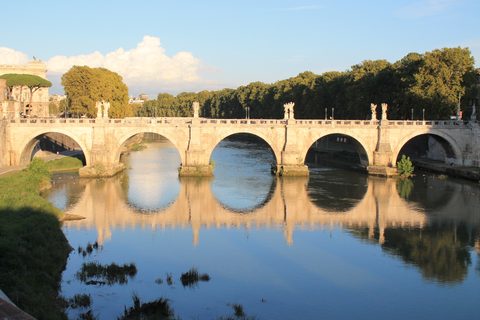
Ponte is the fifth of Rome's twenty-two rioni by toponymic code, and it takes both its name and its coat of arms from a bridge: Ponte Sant'Angelo, which the rione's arms show white on a red field. It is a small, densely built wedge of the left bank between the Tiber and corso Vittorio Emanuele II, and its plan is still medieval. Via dei Coronari runs straight through it because it was the pilgrims' road toward St Peter's; Monte Giordano, the low rise the Orsini fortified, carries Palazzo Taverna on top of it. Ponte holds Santa Maria della Pace with Bramante's cloister behind it, Santa Maria dell'Anima, the Renaissance palace that is now the Museo Nazionale Romano at Palazzo Altemps, the Florentine national church at the head of via Giulia, and three of the bridges that cross toward the Vatican side. The embankment roads built after 1870 erased the lanes that once ran down to the water.
-
sight
The bridge the rione is named and blazoned for, built by Hadrian in 136 AD as the pons Aelius and given ten angels bearing the symbols of the Passion in 1668.
-
A Renaissance palace raised in 1477 for Girolamo Riario, now one of the four sites of the Museo Nazionale Romano; Tuesday to Sunday 09.30 to 19.00, last admission 18.00.
-
Pietro da Cortona's convex front of 1656 for Alexander VII, over a church named for the Peace of Bagnolo, with Raphael's Sibyls and angels of 1514 on the chapel arch.
-
sight
Bramante's cloister of 1500 to 1504 for the adjoining church, an exhibition venue since 1996; hours change with the show, so check chiostrodelbramante.it.
-
The German-speaking community's national church, consecrated in 1542, holding the funerary monument of Pope Adrian VI made between 1524 and 1527.
-
walk
About 500 metres straight through the rione, once called Via Recta, named for the sellers of rosaries who set up shop along the pilgrims' route toward St Peter's.
-
The Florentine national church at the head of via Giulia, from a competition Leo X held in 1518, with Alessandro Galilei's travertine front of 1734; Borromini and Maderno are buried here.
-
sight
Built between 1544 and 1547 for the Arciconfraternita del Gonfalone, with a Passion cycle in twelve episodes painted from 1569 to 1576; visits are arranged through the contacts Roma Capitale gives.
-
sight
Count Giuseppe Primoli's Napoleonic collection, given to the city in 1927 and shown in his rebuilt palace; Tuesday to Sunday 10.00 to 18.00, last entry 17.15.
-
The Pio Sodalizio dei Piceni's galleries, holding the permanent donations of Emilio Greco and Umberto Mastroianni; Tuesday to Saturday 10.00 to 13.00 and 16.00 to 19.00.
-
The church of the banking quarter, consecrated in 432 and made a papal chapel by Innocent III in 1198; it opens 07.00 to 12.00 and 15.00 to 19.00 on weekdays.
-
sight
What survives of the Sanguigni stronghold, where Riccardo Sanguigni was beheaded in 1406 by Paolo Orsini for siding with the Colonna.
-
The square at the left-bank bridgehead, where the rione's article records that condemned prisoners were led in procession and a gallows stood.
-
sight
A pier stub in the river, all that is left of the bridge built under Nero to carry the Via Triumphalis to the right bank.
The rione's edges
Ponte's landward edge is a set of streets and squares it shares with Parione, and Roma Capitale's own street register says so in terms: via del Governo Vecchio, via della Pace, via di Santa Maria dell'Anima, via di Tor Sanguigna, piazza di Tor Sanguigna, piazza del Fico and largo Febo are all recorded as lying in Ponte and in Parione together. The same register records piazza Navona as Parione alone, and corso Vittorio Emanuele II in four rioni at once.
Where a street is shared, a building on it belongs to the rione it physically stands in, not to the whole length of the street it is addressed on. Santa Maria dell'Anima, Palazzo Sacchetti, San Biagio degli Armeni and Santa Maria del Suffragio stand in Ponte, while the streets they are addressed on lie in more than one rione. Via Giulia was opened in 1508 and runs 950 metres from piazza San Vincenzo Pallotti to piazza dell'Oro. Its southern length lies in Regola; its northern length lies in Rione V Ponte.
The bridges divide too. Ponte Sant'Angelo and Ponte Vittorio Emanuele II each lie in Ponte and in Borgo; Ponte Umberto I lies in Ponte and in Prati.
Getting there
No source states a metro station or a bus route for these addresses, so none is given here, and neither are walking times or any distance this guide has not taken from a source. Steer by addresses instead; the whole rione uses the postcode 00186.
Roma Capitale gives the Museo Nazionale Romano at Palazzo Altemps as Via di Sant'Apollinare, 46, and notes that the front on via di Sant'Apollinare carries the main entrance. It gives Santa Maria della Pace and the Chiostro del Bramante as Arco della Pace, 5, which is the small street behind the church front. Santi Celso e Giuliano in Banchi is at Vicolo del Curato, 12, and not on via del Banco di Santo Spirito, where its front stands. San Giovanni Battista dei Fiorentini is at Via Acciaioli, 2, at the head of via Giulia. The Oratorio del Gonfalone is at Via del Gonfalone, 32a. The sanctuary of San Salvatore in Lauro and the museums of the Pio Sodalizio dei Piceni share the number 15 on Piazza di San Salvatore in Lauro but keep separate telephone numbers and separate hours.
Via dei Coronari runs from piazza di Tor Sanguigna to piazza dei Coronari and is about 500 metres long. Via Paola runs from piazza dell'Oro to piazza di Ponte Sant'Angelo, which is the walk from the Florentine church to the bridgehead.
Opening hours, and where there are none
Four places in Ponte publish clock times. Roma Capitale gives the Museo Nazionale Romano at Palazzo Altemps as Tuesday to Sunday 09.30 to 19.00, last admission 18.00, closed Monday. It gives the Museo Napoleonico as Tuesday to Sunday 10.00 to 18.00, last entry 17.15, with 10.00 to 14.00 on 24 and 31 December. It gives the Musei di San Salvatore in Lauro as Tuesday to Saturday 10.00 to 13.00 and 16.00 to 19.00, closed Sunday and Monday. And it gives Santi Celso e Giuliano in Banchi as 07.00 to 12.00 and 15.00 to 19.00 on weekdays, 08.00 to 13.30 and 15.00 to 19.45 on feast days, adding that times may vary.
San Giovanni Battista dei Fiorentini publishes two sets, one for winter and one for July and August, and Roma Capitale asks visitors to contact the church because times may vary. The Chiostro del Bramante is an exhibition venue whose hours change with the show: Roma Capitale states that the ticket office is open every day and closes one hour before the venue, and directs readers to chiostrodelbramante.it for current times.
Everywhere else in this guide, no source states opening hours, so none are given. That includes Santa Maria della Pace, Santa Maria dell'Anima, San Biagio degli Armeni, Santa Maria del Suffragio and the Museo Mario Praz. For Santa Maria della Pace, Roma Capitale gives the telephone number 06 68804038 and says to contact the church about mass times and visiting. For the Oratorio del Gonfalone it gives the telephone number 06 6875952 and the addresses direzioneartistica@oratoriogonfalone.eu and info@oratoriogonfalone.eu, and says to use them to arrange a visit. None of the palazzi in this guide publishes hours, and none of them should be assumed to admit visitors.
Frequently asked questions
- Is Ponte Sant'Angelo in the rione Ponte?
- Partly, and the rione is named after it. it.wikipedia's article on the rione says the bridge lies in Ponte and in Borgo, and that it belonged to the rione until Sixtus V created Borgo in the sixteenth century. The same article gives the rione's arms, citing Carlo Pietrangeli, as the bridge of Sant'Angelo white on a red field. Ponte Vittorio Emanuele II divides the same way; Ponte Umberto I is shared with Prati.
- Is via Giulia in Ponte?
- Its northern length is. Via Giulia was opened in 1508 and runs 950 metres from piazza San Vincenzo Pallotti to piazza dell'Oro. Its southern length lies in Regola; its northern length lies in Rione V Ponte. The buildings on its northern length that stand inside Ponte are Palazzo Sacchetti at no. 66, San Biagio degli Armeni and Santa Maria del Suffragio.
- Which museums in Ponte can you actually walk into?
- Four publish times. The Museo Nazionale Romano at Palazzo Altemps opens Tuesday to Sunday 09.30 to 19.00 with last admission at 18.00. The Museo Napoleonico, a Roma Capitale civic museum in Palazzo Primoli, opens Tuesday to Sunday 10.00 to 18.00 with last entry at 17.15. The Musei di San Salvatore in Lauro open Tuesday to Saturday 10.00 to 13.00 and 16.00 to 19.00 and close Sunday and Monday. The Chiostro del Bramante runs exhibitions whose hours change with the show, so Roma Capitale directs readers to the venue's own site. The Museo Mario Praz shares Palazzo Primoli with the Museo Napoleonico, but no source states its opening hours, so none are given here.
- Is piazza Navona in Ponte?
- No. Roma Capitale's street register records piazza Navona in Parione alone. The line between the two rioni runs through the streets immediately behind the square, several of which the same register records as lying in both. Santa Maria della Pace, Santa Maria dell'Anima and the Chiostro del Bramante stand on the Ponte side of that line.
- Can you go inside the palazzi?
- Assume not. No source states visiting hours for Palazzo Sacchetti, Palazzo Taverna, Palazzo Lancellotti, Palazzo Cesi-Gaddi, Palazzo Milesi, Palazzo Alberini, Palazzo Boncompagni Corcos, Palazzo Capponi Stampa or the Casa di Fiammetta, so none are given here, and Roma Capitale's page for Palazzo Sacchetti gives none either. Two palace interiors in Ponte are open on museum terms rather than as palaces: Palazzo Altemps, which holds the Museo Nazionale Romano, and Palazzo Primoli, which holds the Museo Napoleonico and the Museo Mario Praz.
- What was the Tor di Nona?
- A tower on the river bank that gave its name to a lungotevere, a theatre and a set of prisons. it.wikipedia records that the tower passed to the hospital of the Compagnia del Salvatore in 1395 under the will of Giovanni di Jacobello Orsini, and that the name probably comes from its being the ninth tower counting from Porta Flaminia. From the early fifteenth century the prisons there and those of Corte Savella were together called the presone dello papa, a name they kept until 1657. Nothing of the prisons survives. The Teatro Tordinona on via degli Acquasparta carries forward the name of the Teatro Apollo-Tordinona, which stood on the prison site and was demolished in 1888.
Connected pages
Nearby
-
Borgo, Rome: Castel Sant'Angelo, the Leonine City and the Quarter That Was Demolished
· Borgo, Rome
Ponte Sant'Angelo and Ponte Vittorio Emanuele II each lie in Ponte and in Borgo, where Ponte Sant'Angelo meets Castel Sant'Angelo.
-
Parione, Rome: Piazza Navona, Campo de' Fiori and the Cancelleria
· Parione, Rome
Ponte's landward neighbour. Roma Capitale's register puts piazza Navona wholly in Parione, and several streets behind it in both rioni.
-
Prati, Rome: the Palazzaccio, a Caryatid Fountain and the Only Rione Outside the Walls
· Prati, Rome
Ponte Umberto I crosses into Prati, which holds three further Tiber bridges of its own.
-
Regola, Rome: Palazzo Farnese, via Giulia and the national churches
· Regola, Rome
Via Giulia's northern length lies in Rione V Ponte, which holds Palazzo Sacchetti, the Oratorio del Gonfalone and the Museo Criminologico.
-
Campo Marzio, Rome: the Spanish Steps, piazza del Popolo, the Augustan monuments and the Pincio
· Campo Marzio, Rome
The neighbour south-west across via del Cancello, along the Tiber bend.
See also
-
3 Days in Rome: Colosseum Arena Floor, the Vatican, and the Back Streets of Monti
· Rome, Italy
The three-day Rome itinerary in this series, which crosses Ponte Sant'Angelo on its way to the Vatican.
What travelers think
Log in to react.
No reviews yet.