
Testaccio, Rome: the ancient river port, the mountain of amphorae and the slaughterhouse quarter
Testaccio, Rome
Pictures from Testaccio
See all 1 photos →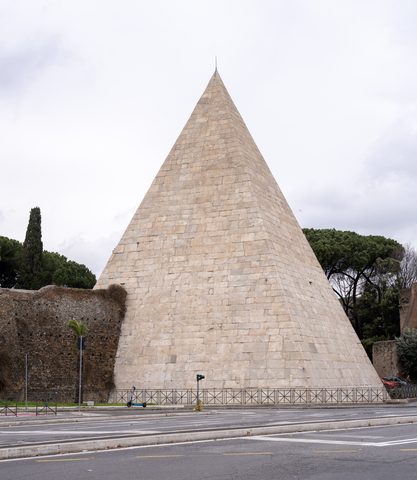
Testaccio is R. XX, the twentieth of Rome's rioni by toponymic code, and it was carved out of Ripa in 1921. It covers about sixty hectares on the left bank of the Tiber, and it is a modern quarter standing on very old ground. The quay of Rome's ancient river port is set into the embankment wall; Monte Testaccio, an artificial hill 54 metres high and about a kilometre round, is built of the stacked sherds of the oil amphorae emptied at that port. Above them the city laid out a residential quarter from the end of the nineteenth century for the workers of the industries settling along the via Ostiense, and named its streets for engineers, printers, navigators and scientists: Volta, Galvani, Franklin, Manuzio, Bodoni, Ghiberti, Vespucci, Zabaglia. The slaughterhouse of 1888 to 1891 is now an arts campus, and the market moved into a new hall in 2012.
-
sight
An artificial hill 54 metres high, built of the broken oil amphorae unloaded at the river port between the Augustan period and the middle of the 3rd century AD; visits are by booking only, for groups with their own guide.
-
sight
The tomb of Gaius Cestius, 36.40 metres high on a base 29.50 metres a side, finished in 330 days under the terms of his will and later taken into the Aurelian Walls as a bastion.
-
A burial ground active since 1716, holding over 6,000 graves from more than fifty religious denominations, among them those of Keats, Shelley and Gramsci.
-
About 500 metres of travertine quay survive in the embankment wall, with stairs, ramps and projecting mooring blocks; Roma Capitale says it can be visited only on extraordinary openings.
-
sight
Piers of a warehouse 487 metres long stand between the apartment blocks; whether it is the Porticus Aemilia of the literary sources or a set of republican navalia is still argued.
-
sight
The slaughterhouse Gioacchino Ersoch built between 1888 and 1891, 25,000 square metres of pavilions, decommissioned in 1975 and now an exhibition campus open when a show is running.
-
sight
Pietro Lombardi's travertine fountain of massed amphorae, inaugurated on 26 October 1927, moved away in 1935 and brought back to the square block by block in 2015.
-
sight
The ground where A.S. Roma played 161 home matches between 1929 and 1940, with four wooden stands in gold and Pompeian red and a free view from the top of Monte dei Cocci.
-
The covered market, open Monday to Saturday from 07.00 to 15.30, with four entrances and, beneath the trading floor, the remains of a Roman horreum.
-
food
A restaurant on via di Monte Testaccio cooking the quinto quarto, with rigatoni con la pajata and coda alla vaccinara on its own list; closed Monday and Tuesday.
-
food
Open every day on via Mastro Giorgio, for lunch from 12.30 and dinner from 19.00; the cacio e pepe is finished at the table.
-
food
A delicatessen at via Marmorata 47 selling cured meats, cheeses, baked goods and wine.
-
The road round the foot of the hill, where caves cut for cellars and stables, held at about 10 degrees Celsius by the clay, now hold restaurants and clubs.
-
Seventeen teaching panels set across the rione by the Soprintendenza Speciale, freely accessible, with bookings for the enclosed sites at sottosopra.testaccio@gmail.com.
Where the rione's boundaries run
Several things a visitor would file under Testaccio stand in the rione next door, and the inventory of the Museo diffuso di Testaccio says so itself in two places: the Palazzo delle Poste on via Marmorata is in rione San Saba, and the Arco di San Lazzaro is in rione Ripa. Porta San Paolo, the Museo della Via Ostiense housed inside it, the square in front of it and the stations around it are in San Saba and in the quartiere Ostiense. The tomb of Servius Sulpicius Galba is a third case of the same shape. What stands on via Giovanni Branca is a museo diffuso panel telling the tomb's story; the tomb itself is at the Parco archeologico del Celio.
Via Marmorata runs along the rione boundary, with Ripa at one end and San Saba at the other, and buildings addressed on it belong to three different rioni. Piazza dell'Emporio, at the eastern landing of Ponte Sublicio, is in Ripa.
The Pyramid of Cestius was taken into the Aurelian Walls as a bastion, and the walls carry a rione boundary. The Soprintendenza Speciale addresses the monument on the Testaccio side, at via Raffaele Persichetti, it.wikipedia files it under R. XX Testaccio, and the administration of the Non-Catholic Cemetery, which states its own address as being in the Rione di Testaccio, orients its visitors by the Pyramid as the thing on the other side of its wall. Roma Capitale's tourism service states that the present Ponte Sublicio joins the rioni of Trastevere and Testaccio at Porta Portese.
Getting there
Metro line B stops at Piramide, and every operator in the rione that publishes transport gives that station first. For the Pyramid of Cestius the Soprintendenza Speciale adds bus 23, 75, 280 and 716 and tram 3 and 8. The Non-Catholic Cemetery gives bus 3, 23, 30, 60, 75, 83, 95, 175 and 280 and the same metro station. The Mattatoio gives Metro B Piramide, tram 3 at Marmorata/Galvani, bus 719 at Galvani/Zabaglia and buses 170 and 781 at largo Marzi; the Città dell'Altra Economia, in the same complex, gives Metro B Piramide and bus 719, and has bike racks and a large car park.
Once you are in the rione, steer by addresses. Monte Testaccio is entered from via Nicola Zabaglia 24. The Non-Catholic Cemetery is at via Caio Cestio 6, and its own directions say that via Caio Cestio is a turning off via Marmorata on the north side of the Pyramid, with the entrance on the left halfway along the street. The Pyramid is entered from via Raffaele Persichetti. Roma Capitale's tourism service gives the Mattatoio as piazza Orazio Giustiniani 4, and the operator still uses the via Beniamino Franklin gate as the main entrance. The Nuovo Mercato Testaccio has entrances on via Beniamino Franklin, via Alessandro Volta, via Aldo Manuzio and via Lorenzo Ghiberti; the archaeological area beneath it is reached from inside the hall, with the assembly point at stall 63. The Emporium quay is on Lungotevere Testaccio, opposite no. 11. The Rome War Cemetery is on via Nicola Zabaglia. The fire brigade's museum is at via Galvani 2, with the barracks entrance at via Marmorata 15.
The street names themselves are a usable map. The rione's streets are dedicated to explorers, navigators, entrepreneurs, shipowners, engineers, scientists, publishers, printers and artists, which is why a walk here runs Volta, Galvani, Franklin, Manuzio, Bodoni, Ghiberti, Vespucci, Rubattino and Zabaglia.
Getting in to the ancient city
Almost all of Roman Testaccio is buried, built over or behind a gate, and each site has its own regime. Read them before you plan a day around any of them.
Monte Testaccio is opened by booking only, to groups bringing their own guide, up to thirty people a visit, on 060608 between 09.00 and 19.00. The Sovrintendenza Capitolina's tariff is 4.00 euro full and 3.00 euro reduced, free for residents of Rome and the metropolitan area on production of proof of residence and free for MIC card holders; the price does not include a guide. The same page advises low comfortable shoes, states that the site is not accessible to wheelchair users and that there are no toilets, and forbids approaching the edges of the hill, going onto the slopes and picking up sherds.
The Emporium, the ancient quay in the embankment wall, is described by Roma Capitale's tourism service as visitable only on extraordinary openings, which are booked through the Museo diffuso di Testaccio at sottosopra.testaccio@gmail.com. The horreum under the Nuovo Mercato is shown by the archaeologists who excavated it, in visits of about forty-five minutes for groups of up to twenty, free with an optional donation, on open days announced by the market's traders; the market states that visits are suspended while the spaces are refurbished. The Pyramid of Cestius opens on an announced cycle rather than daily: after works funded under the PNRR, the Soprintendenza Speciale announced openings between 4 September and 31 October 2026, with compulsory booking through Eventbrite, and outside announced openings the monument is not open to visitors.
The Porticus Aemilia asks nothing of you. Its piers stand between the apartment blocks of via Giovanni Branca, via Rubattino and via Florio, and the archaeological park around them, part of the museo diffuso, has entrances on via Rubattino and via Beniamino Franklin. The rione route of the museo diffuso itself is described by Roma Capitale as freely accessible, and seventeen of its panels stand in the rione.
Frequently asked questions
- Is the Pyramid of Cestius in Testaccio, and can you go inside it?
- The bodies that publish on it place it in Testaccio. The Soprintendenza Speciale gives its entrance as via Raffaele Persichetti, on the Testaccio side, it.wikipedia files it under R. XX Testaccio, and the Non-Catholic Cemetery, whose administration states that it is itself in the Rione di Testaccio, orients visitors by the monument. Going in depends on the calendar. After works funded under the PNRR the Soprintendenza Speciale announced a cycle of openings between 4 September and 31 October 2026: unguided daytime visits on 5, 12 and 19 September and 3, 10, 17, 24 and 31 October at 16.30, 17.30 and 18.30 for up to fifty people a turn; free guided evening visits on 4, 11, 18 and 25 September at 19.00, 20.00 and 21.00 for up to thirty; and openings for the European Heritage Days on 26 and 27 September, hourly from 10.00 to 16.00. Each visit runs forty-five minutes, booking through Eventbrite is compulsory, entry is free, and outside announced openings the monument is not open to visitors.
- Is Porta San Paolo in Testaccio?
- No, and neither is the Museo della Via Ostiense inside the gate, nor piazza di Porta San Paolo, nor the 1943 memorial plaques, nor the metro and rail stations around them. The gate and its museum belong to rione San Saba, and the transport around piazzale Ostiense to the quartiere Ostiense. The it.wikipedia article on Testaccio lists the gate among the rione's archaeological sites, and this guide does not follow it.
- Can you climb Monte Testaccio?
- Only on a booked visit. The Sovrintendenza Capitolina, which manages the hill, opens it to groups that bring their own guide, up to thirty people, with compulsory booking on 060608 between 09.00 and 19.00; individual visits are also possible by booking on a published calendar. The tariff is 4.00 euro full and 3.00 euro reduced, free for residents of Rome and the metropolitan area on production of proof of residence and free for MIC card holders, and it does not include a guide. The Sovrintendenza advises low comfortable shoes, states that the site is not accessible to wheelchair users and that there are no toilets, and forbids going onto the slopes, approaching the edges and picking up sherds.
- When is the Non-Catholic Cemetery open, and who is buried there?
- Its administration gives Monday to Saturday 09.00 to 17.00, last admission 16.30, and Sundays and public holidays 09.00 to 13.00, last admission 12.30. It closes on 1 and 6 January, for fifteen days around Ferragosto, and on 8, 24, 25, 26 and 31 December, and closes at 13.00, last entry 12.30, at Easter and Easter Monday, on 25 April, 1 May and 2 and 29 June; it also cautions that it may close without notice for reasons beyond its control. It states that it does not at present offer guided visits, so groups bring their own guide and book a slot. It has been an active burial ground since 1716, holds over 6,000 burials representing more than fifty religious denominations from nearly sixty countries, and is the burial place of John Keats, Percy Bysshe Shelley, Antonio Gramsci, Carlo Emilio Gadda, Andrea Camilleri, Arnoldo Foà, August von Goethe and Hans von Marées.
- What was Campo Testaccio?
- A football ground on via Nicola Zabaglia, now the Parco Testaccio. A.S. Roma played its home matches there from 3 November 1929 to 30 June 1940 — 161 matches, 103 won, 32 drawn, 26 lost. The engineer Silvio Sensi designed it on the model of British grounds, and Goodison Park in particular, with four wooden stands painted in the club's gold and Pompeian red, a capacity of 20,000 and a pitch whose dimensions could be adjusted. It was abandoned at the end of the 1939–40 season as obsolete and demolished that October.
- Where do you eat in Testaccio?
- The covered market on via Lorenzo Ghiberti opens Monday to Saturday from 07.00 to 15.30 and describes itself as a hundred stalls, a hundred stories, a thousand products. Nine further addresses trade in the rione, each on what its own operator publishes: the delicatessen Volpetti on via Marmorata; the pasticcerie Barberini on via Marmorata and Linari on via Nicola Zabaglia; the trattorie Perilli on via Marmorata, Da Bucatino on via Luca della Robbia and Lo Scopettaro on Lungotevere Testaccio; Felice a Testaccio on via Mastro Giorgio; and, on via di Monte Testaccio, Checchino dal 1887 and Flavio al Velavevodetto.
Connected pages
Nearby
-
Ripa, Rome: the Forum Boarium, the Circus Maximus, the Aventine and the Tiber island
· Ripa, Rome
The neighbour across via Marmorata, holding piazza dell'Emporio, the Circus Maximus, Santa Maria in Cosmedin and the Tiber island.
-
San Saba, Rome: the Baths of Caracalla, Porta San Paolo and the Piccolo Aventino
· San Saba, Rome
The neighbour at the other end of via Marmorata, holding Porta San Paolo, the Museo della Via Ostiense and the Baths of Caracalla.
-
Ostiense, Rome: San Paolo fuori le Mura, Centrale Montemartini and Garbatella
· Ostiense, Rome
The rione north across the Aurelian Walls, which holds the Piramide di Caio Cestio and the stretch of walls beside it.
Shared history
-
San Saba, Rome: the Baths of Caracalla, Porta San Paolo and the Piccolo Aventino
· San Saba, Rome
The other rione carved out of Ripa in 1921, across Via Marmorata, and the one that holds the Pyramid of Cestius.
Same region
-
Trastevere (R. XIII), Rome: Fountains, the Janiculum and 1849
· Trastevere, Rome
Across the Tiber. Roma Capitale says Ponte Sublicio joins the rioni of Trastevere and Testaccio at Porta Portese.
-
EUR, Rome: the E42 palazzi, the lake park and the 1960 Olympic venues
· EUR, Rome
R. XX Testaccio, the rione at the Pyramid and the Aurelian Walls, where the road out to EUR begins.
-
Ostia Lido, Rome: Q. XXXIII at the mouth of the Tiber, its two towers and the seaplane base
· Ostia Lido, Rome
A rione in this series, on the Tiber upstream of Ostia, with the Pyramid of Cestius and the Monte dei Cocci.
See also
-
3 Days in Rome: Colosseum Arena Floor, the Vatican, and the Back Streets of Monti
· Rome, Italy
The three-day Rome itinerary in this series, for fitting a morning in Testaccio around the centre.
What travelers think
Log in to react.
No reviews yet.