
Golden Gate Park, San Francisco: the Music Concourse, the gardens, Stow Lake and the windmills
Golden Gate Park, California
Pictures from Golden Gate Park
See all 1 photos →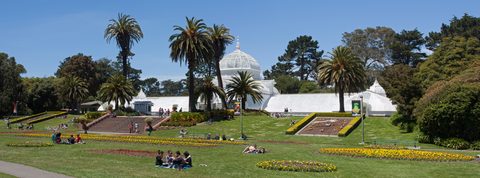
Golden Gate Park is a rectangle of about 1,017 acres, half a mile wide and three and a half miles long, running from Stanyan Street to the Great Highway, with the Panhandle carrying on east between Oak Street and Fell Street to Baker Street. It was listed on the National Register of Historic Places on 15 October 2004, reference number 04001137. William Hammond Hall surveyed the site in 1870 and became its first superintendent in 1871; John McLaren held the post from 1890 until his death in 1943, and a man-made forest of over 30,000 trees covers the ground they planted. The Music Concourse holds the de Young Museum, the California Academy of Sciences and the Japanese Tea Garden. West of it are Stow Lake, the Polo Field, the bison paddock, two windmills and the Beach Chalet at 1000 Great Highway.
-
Open 9:30 a.m. to 5 p.m. Monday to Saturday and 11 a.m. to 5 p.m. on Sunday at 55 Music Concourse Drive, with Thursday NightLife from 6 to 10 p.m.
-
sight
The art museum at 50 Hagiwara Tea Garden Drive, on the north side of the Music Concourse; no source states its opening hours.
-
sight
At 75 Hagiwara Tea Garden Drive, with a five-story pagoda, a tea house of 1894, a dry landscape garden of 1953 and a bronze Buddha cast in 1790.
-
sight
The wood and glass conservatory of 1878: San Francisco Landmark No. 50, designated in 1972, and listed on the National Register in 1971, reference number 71000184.
-
At 1199 9th Avenue: 55 developed acres of a 70-acre site, showing more than 8,000 different kinds of plants, opened in May 1940.
-
sight
The sunken oval between the two museums, planted with London Plane and Scotch Elm: San Francisco Landmark No. 249, designated in 2005.
-
walk
A lake of 12.7 acres around Strawberry Hill, crossed by the Roman Bridge and the Rustic Stone Bridge, both of 1893 by Arthur Page Brown.
-
walk
A strip one block wide and eight blocks long between Oak Street and Fell Street, with a bicycle path on the north side and a footpath on the south.
-
sight
Built in 1902 to pump water to the Strawberry Hill reservoir, 75 feet tall: San Francisco Landmark No. 147, designated in 1981.
-
sight
Built in 1905, 95 feet tall with a span of 114 feet: San Francisco Landmark No. 210, designated in 2000, with the Millwright's Cottage.
-
On the upper floor at 1000 Great Highway, open 11 a.m. to 9 p.m. on weekdays and 10 a.m. to 9 p.m. at weekends, with brunch from 10 a.m. to 2:30 p.m.
-
food
Row and pedal boats by the hour at the north part of Stow Lake, with a cafe serving from lattes to local wine and from hamburgers to salads.
-
The playground of about 1888 below the Sharon Building, with five cast concrete animals by Vicki Saulls of 2007 and the carousel beside it.
-
tip
The fenced paddock in the western half of the park; bison came to the park in 1890 and the herd was moved to this ground around 1900.
The Music Concourse, the museums and the gardens
The Music Concourse is the sunken oval at the Stanyan Street end of the park, with the de Young Museum on its north side at 50 Hagiwara Tea Garden Drive and the California Academy of Sciences on its south at 55 Music Concourse Drive. The bowl sits approximately ten feet below the surrounding roadway; its surface is asphalt paths with fields of decomposed granite at the southwest end and turf at the northeast end, planted with a bosque of pollarded deciduous trees, primarily London Plane and Scotch Elm. It is San Francisco Landmark No. 249, designated in 2005 under Ordinance File No. 051590, and the ordinance draws the landmark boundary to include the three pedestrian tunnels that run under the concourse. The Spreckels Temple of Music closes its west end: a masonry and concrete bandshell clad on the exterior with Colusa sandstone, built in 1900 with funds donated by the sugar magnate Claus Spreckels to a design by the Reid Brothers, with a central half-dome and two flanking colonnades of eight pairs of Ionic columns.
Monuments stand around the oval. The Miguel de Cervantes Memorial by Joseph Jacinto Mora, bronze and natural stone of 1916, shows Cervantes looking down at Don Quixote and Sancho Panza kneeling before him. Two cast concrete sphinxes by Arthur Putnam of 1903 flank the footpath entrance to the de Young parking area. The Robert Emmet Memorial by Jerome Connor, bronze on granite of 1919, was the gift of James D. Phelan, and Eamon De Valera, President of the Irish Republic in 1919, spoke at its dedication. The Goethe and Schiller Monument by Ernst Rietschel dates from 1901, the Ludwig van Beethoven Monument from 1915, the gift of the Beethoven Maennerchor of New York and dedicated on 15 August 1915. The Giuseppe Verdi Monument by Orazio Grossoni, a 52-ton statue, was the gift of the Italian Colony of San Francisco.
The Japanese Tea Garden is at 75 Hagiwara Tea Garden Drive, open every day from 9 a.m. to 4:45 p.m. in winter and 9 a.m. to 5:45 p.m. in summer, with the gate closing at 4:30 p.m. and 5:30 p.m. George Turner Marsh created it as a Japanese Village feature of the 1894 Mid Winter Exposition and Makoto Hagiwara designed and constructed it; it was expanded from one acre to five in 1902. The Conservatory of Flowers stands above Conservatory Valley on John F. Kennedy Drive: San Francisco Landmark No. 50, designated in 1972, and listed on the National Register of Historic Places in 1971, reference number 71000184. It was acquired for the park from an estate while it was still in crates and constructed in 1878.
East of the concourse are the Children's Quarter, the Sharon Building of 1888, which is San Francisco Landmark No. 124, designated in 1981, and the carousel in its 1889 building of sixteen fluted, tapered wood Doric columns. The Shakespeare Garden of 1928 carries six bronze panels with 88 floral quotations. McLaren Lodge, San Francisco Landmark No. 175, designated in 1984, stands at 501 Stanyan Street. Kezar Stadium is at 670 Kezar Drive, and Kezar Pavilion, a gymnasium building of 1926 with seats for four thousand, fronts on Stanyan Street.
West through the park: lakes, meadows and the windmills
Stow Lake wraps around Strawberry Hill in the middle of the park: 12.7 acres, completed along with Huntington Falls in 1893, crossed by the Roman Bridge on the north side and the Rustic Stone Bridge over the south arm, both of 1893 by the architect Arthur Page Brown. Huntington Falls drops approximately 90 feet down the flank of the hill in concrete sculpted to look like natural rock, and the Chinese Pavilion of 1981, a gift from the sister city Taipei, stands at the water. The boathouse at the north part of the lake rents American-made row and pedal boats by the hour and runs a cafe. The San Francisco Botanical Garden is at 1199 9th Avenue: 55 developed acres of a 70-acre site, showing more than 8,000 different kinds of plants.
West of Crossover Drive the park opens out. The Polo Field, formally the Golden Gate Park Stadium, is a 17-acre field inside a 10-foot graded berm with a trotting track on top, with eighteen sections of concrete stands lining the embankment on the north side and another six on the south. Anglers' Lodge of 1936 overlooks fly casting pools 450 feet wide by 185 feet long. Spreckels Lake, approximately six acres, is used for model boating, and the model yacht clubhouse of 1938 stands beside it. The bison paddock is a large fenced open space with a feeding shelter and isolation pens at its west end; bison were introduced into the park in 1890 and the herd was moved to this ground around 1900. The Chain of Lakes, North, Middle and South, were made in 1898.
At the Great Highway end stand two windmills. The Dutch Windmill of 1902 is 75 feet tall on a 5-foot-thick concrete foundation 33 feet across, and is San Francisco Landmark No. 147, designated in 1981. The Murphy Windmill of 1905 is 95 feet tall with a span of 114 feet, and together with the Millwright's House it is San Francisco Landmark No. 210, designated in 2000. The Queen Wilhelmina Tulip Garden lies beside the Dutch Windmill. The Beach Chalet at 1000 Great Highway is San Francisco Landmark No. 179, designated in 1985, and was listed on the National Register of Historic Places on 22 July 1981, reference number 81000172; Lucien Labaudt's fresco People and Places of San Francisco of 1936 is inside it, with a visitor center on the ground floor and a brewery and restaurant above. The Roald Amundsen Monument of red Norwegian granite and bronze stands north of the building.
Getting there
Steer by the gates and by the addresses.
The gates: Arguello Gate at Fulton Street and Arguello Boulevard, two large pylons and flanking walls of stone ornamented with polychrome terra cotta and copper metal urns and globes; Brown Gate at 8th Avenue and Fulton Street, with a bronze Bear on the northeast corner and a bronze Lion on the northwest corner; Breon Gate at 19th Avenue and Lincoln Way, two large ornamented stone pylons; and two boulder groupings inscribed with the name Golden Gate Park, one at the Great Highway and John F. Kennedy Drive entry and one at the Fulton Street and Martin Luther King Jr. Drive entry.
The addresses: the de Young Museum, 50 Hagiwara Tea Garden Drive; the California Academy of Sciences, 55 Music Concourse Drive; the Japanese Tea Garden, 75 Hagiwara Tea Garden Drive; the San Francisco Botanical Garden, 1199 9th Avenue; McLaren Lodge, 501 Stanyan Street; Kezar Stadium, 670 Kezar Drive; and the Beach Chalet, 1000 Great Highway. The San Francisco Model Yacht Club gives its own location as the 36th Avenue and Fulton Street entrance.
The park runs between Fulton Street on the north and Lincoln Way on the south, from Stanyan Street west to the Great Highway, and the Panhandle carries on east between Oak Street and Fell Street as far as Baker Street. A stone masonry wall of rustic stone-like rectangular blocks runs along Stanyan Street from Fell Street and along Fulton Street to 2nd Avenue.
Frequently asked questions
- When are the Japanese Tea Garden and the California Academy of Sciences open?
- The Japanese Tea Garden at 75 Hagiwara Tea Garden Drive is open every day, 9 a.m. to 4:45 p.m. in winter and 9 a.m. to 5:45 p.m. in summer, with the gate closing at 4:30 p.m. in winter and 5:30 p.m. in summer. The California Academy of Sciences at 55 Music Concourse Drive is open Monday to Saturday from 9:30 a.m. to 5 p.m. and Sunday from 11 a.m. to 5 p.m., and holds Thursday NightLife from 6 to 10 p.m. for visitors of 21 and over. No source states opening hours for the de Young Museum, the Conservatory of Flowers or the San Francisco Botanical Garden, so none are given here.
- Which buildings in the park carry a register citation?
- The Conservatory of Flowers is San Francisco Landmark No. 50, designated in 1972, and was listed on the National Register of Historic Places in 1971, reference number 71000184. The Sharon Building is San Francisco Landmark No. 124, designated in 1981. The Dutch Windmill, recorded as the North Windmill, is San Francisco Landmark No. 147, designated in 1981. McLaren Lodge is San Francisco Landmark No. 175, designated in 1984. The Beach Chalet is San Francisco Landmark No. 179, designated in 1985, and was listed on the National Register of Historic Places on 22 July 1981, reference number 81000172. The Lawn Bowling Clubhouse and Greens is San Francisco Landmark No. 181, designated in 1986. The Murphy Windmill and Millwright's Cottage is San Francisco Landmark No. 210, designated in 2000. The Music Concourse is San Francisco Landmark No. 249, designated in 2005. The park itself was listed on the National Register of Historic Places on 15 October 2004, reference number 04001137.
- What is there at Stow Lake?
- A lake of 12.7 acres around Strawberry Hill, completed in 1893 and built with a 10-inch layer of clay under a 3-inch layer of crushed rock rolled into it. Two bridges of 1893 by the architect Arthur Page Brown cross it: the Roman Bridge, a gentle arch of iron-reinforced smooth-finished concrete, on the north side, and the Rustic Stone Bridge, a more steeply arching pedestrian bridge covered with bulging rustic stones, over the south arm. Huntington Falls, approximately 90 feet high, was completed with the lake in 1893, collapsed after a broken irrigation line undermined its foundations in 1962, and was completely reconstructed in 1984. The boathouse at the north part of the lake rents American-made row and pedal boats by the hour and runs a cafe serving from lattes to local wine and from hamburgers to salads; no source states its opening hours, so none are given here.
- Where are the windmills, and what is the Beach Chalet?
- The Dutch Windmill stands at the northwest corner of the park near the Great Highway: built in 1902 to pump water from wells to the reservoir on Strawberry Hill, designed by Alpheus Bull, Jr., 75 feet tall with a 5-foot-thick concrete foundation 33 feet in diameter, San Francisco Landmark No. 147, designated in 1981. The Murphy Windmill stands at the southwest corner: built in 1905 with funds donated by Samuel Murphy, 95 feet tall with a span of 114 feet, and with the Millwright's House it is San Francisco Landmark No. 210, designated in 2000. The Beach Chalet at 1000 Great Highway is a stucco Spanish-Moorish revival pavilion of 1925 designed by Willis Polk, with a visitor center on the ground floor and a brewery and restaurant above, open Monday to Friday 11 a.m. to 9 p.m. and Saturday and Sunday 10 a.m. to 9 p.m. It is San Francisco Landmark No. 179, designated in 1985, and was listed on the National Register of Historic Places on 22 July 1981, reference number 81000172.
- What is the Panhandle?
- A strip one block wide and eight blocks long, running east from the end of the park between Oak Street and Fell Street, from Stanyan Street to Baker Street. It was laid out about 1872, was originally called The Avenue, and was constructed as a connecting carriage road from the edge of the developed city to the park, with a meandering roadway down the centre lined with trees and shrubs to mitigate the prevailing westerly winds. Two paths run its length today, the northern one for bicyclists and the southern one for pedestrians. The William McKinley Monument by Robert Ingersoll Aitken, bronze and marble on granite of 1904, stands at Fell Street and Baker Street, with a fifteen-foot bronze figure representing Justice at the top of its pedestal. A playground and a basketball court stand on the strip; the playground equipment was installed in 1996.
Connected pages
Nearby
-
Haight-Ashbury, San Francisco: Haight Street, Buena Vista Park and the Doolan-Larson Building
· Haight-Ashbury, California
The neighbour across Stanyan Street, at the Haight Street entrance and Alvord Lake.
-
Inner Richmond, San Francisco: Clement Street, the Columbarium and the Richmond branch library
· Inner Richmond, California
The neighbour along the north side of Fulton Street, from Arguello Boulevard west.
-
Inner Sunset, San Francisco: Irving Street, Grand View Park and the Mount Sutro trails
· Inner Sunset, California
The neighbour along the south side of Lincoln Way, by the 9th Avenue entrance and the Botanical Garden.
-
Ocean Beach, San Francisco: the strand, Sutro Heights, the Sutro Baths ruins and Lands End
· Ocean Beach, California
The shore across the Great Highway from the Beach Chalet and the western entry monuments.
Same region
-
The Presidio, San Francisco: Fort Point, Crissy Field, the Main Post and the coast batteries
· The Presidio, California
The city's other large park, with the Beach Chalet, the Dutch and Murphy windmills and the Japanese Tea Garden.
-
Japantown, San Francisco: the Peace Pagoda, the Japan Center malls and Cottage Row
· Japantown, California
The park holding the Japanese Tea Garden, the de Young Museum and the California Academy of Sciences.
What travelers think
Log in to react.
No reviews yet.