
Sutton, London: Carshalton Ponds, Honeywood Museum, Whitehall in Cheam, Carew Manor and Little Holland House
Sutton, England
Pictures from Sutton
See all 1 photos →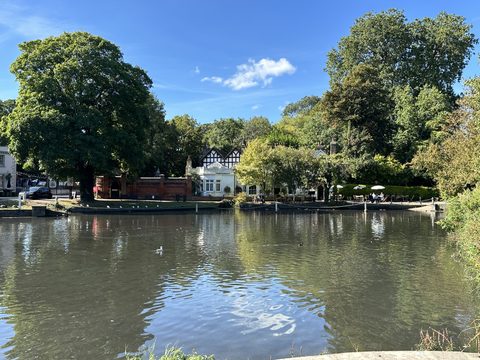
Sutton is an outer London borough, and the River Wandle rises inside it. Carshalton village stands at the springs, with two spring-fed ponds, a medieval parish church, a seventeenth-century house now a museum, an eighteenth-century water pavilion and a Palladian bridge within four hundred metres of one another. Cheam keeps a timber-framed yeoman's house of about 1500 and the chancel of a demolished medieval church. Beddington and Wallington hold the Carew family's manor, its dovecote and its parish church together in one public park on the Wandle. Sutton town centre and the chalk heights south of it carry the parish church of the town that named the borough, an Arts and Crafts house built between 1902 and 1904, and an eighteenth-century pleasure ground that named a Classic horse race. The National Heritage List for England records 216 designations in the borough: 209 listed-building entries, six scheduled monuments and one registered park and garden.
-
tour
A seventeenth-century chequer house facing Carshalton Ponds, listed Grade II as NHLE 1065645; Thursday to Saturday 10:00-17:00, admission free.
-
An early eighteenth-century water pavilion with a tile-lined plunge bath, listed Grade II* as NHLE 1183926; Sunday afternoons after Easter to the end of September, cash only.
-
Two spring-fed ponds at the head of the Wandle, either side of North Street, with the Leoni Bridge listed Grade II as NHLE 1065681.
-
A tower with work predating the Norman Conquest and a Willis organ in a gallery by Ninian Comper, listed Grade II* as NHLE 1065683.
-
1.3 hectares of Local Nature Reserve off Festival Walk, with the old Wandle channel running through it and the Grade II* Old Rectory, NHLE 1183473, in the grounds.
-
A public hall of 1874, a skating rink to 1912 and a cinema to 1939, opened as a theatre in 1991 and trading as the CryerArts Centre with a restaurant and bar.
-
Built about 1724 for a mansion by Giacomo Leoni that was never finished, listed Grade II as NHLE 1065628; the Wandle once rose beneath it.
-
tour
A timber-framed yeoman's house of about 1500, listed Grade II* as NHLE 1357580, reopened in June 2018 with a gallery on Nonsuch Palace.
-
sight
The chancel of Cheam's medieval church, kept standing in 1864 for the Lumley monuments, listed Grade II* as NHLE 1183440 and cared for by the Churches Conservation Trust.
-
The parish church of 1864 that replaced the medieval one, listed Grade II* as NHLE 1065676, sharing its churchyard with the Lumley Chapel.
-
walk
Parkland on the grounds of the demolished Cheam Park House, adjoining Nonsuch Park, whose registered area, NHLE 1001672, straddles the Surrey boundary.
-
A medieval hammerbeam roof listed Grade I as NHLE 1065672, seen by arrangement and on open days because council offices and a school hold the building.
-
sight
An early eighteenth-century brick dovecote in Beddington Park, listed Grade II* as NHLE 1065674 and separately a scheduled monument, NHLE 1002017.
-
A fourteenth-century flint church holding the Carew tombs, with an organ screen by William Morris, listed Grade II* as NHLE 1065670.
-
walk
The former deer park of Carew Manor, with a boating lake, the Wandle running east to west, and a Roman villa scheduled as NHLE 1001990 underground in the east.
-
The parish church of the town that named the borough, listed Grade II* as NHLE 1065629, in a small ancient wooded graveyard bombed in 1940.
-
tour
Frank R. Dickinson built the house and its furniture himself between 1902 and 1904; listed Grade II as NHLE 1065699, free, usually the first Sunday of each month.
-
walk
Chalk downland at the southern tip of the borough; the Earl of Derby named The Oaks of 1779 after the demolished villa whose stables are Grade II, NHLE 1245718.
Carshalton village and the ponds
Carshalton village sits on the springs at the head of the River Wandle, and the ponds are the centre of it. Two adjoining spring-fed ponds lie either side of North Street, off the High Street, SM5 3AL, and they are one of the sources of the Wandle. The Leoni Bridge is listed Grade II, NHLE 1065681, on 16 March 1954, under the entry name "The Leoni Bridge. North retaining wall of the pond to the east of North Street". The pond walls and culverts carry their own entries: the south-east culvert and the south and east retaining walls of the pond east of North Street, Grade II, NHLE 1065680, and the road bridge, embankment retaining walls and railings of the pond west of North Street, Grade II, NHLE 1300556. Anne Boleyn's Well, the spring beside All Saints Church, is Grade II, NHLE 1065668; the story that the spring rose where Anne Boleyn's horse kicked a stone is folklore, and scholars suggest the name is a corruption of Boulogne, after the Counts of Boulogne who held land here in the twelfth century. All of it stands inside the Carshalton Village Conservation Area, designated by the London Borough of Sutton, and conservation areas carry no list entry number.
The Church of All Saints, High Street, SM5 3PD, is listed Grade II*, NHLE 1065683, on 16 March 1954. A church has stood on the site since at least Norman times, the tower contains work predating the Norman Conquest, and twelfth-century fabric survives; a large renovation in 1891 added the nave and north aisle. The three-manual Willis organ stands in a west-end gallery designed by Ninian Comper. Several churchyard structures are separate entries and are not the church: the north churchyard wall including the former fire-engine house at its west end, Grade II, NHLE 1065684; the east and west churchyard walls, Grade II, NHLE 1183508; and the gates adjoining No 1 at the south-west entrance to The Grove, Grade II, NHLE 1065682. Carshalton War Memorial nearby is Grade II, NHLE 1393681. No source states the church's opening hours, so none are given here.
Honeywood Museum faces the ponds from Honeywood Walk, SM5 3NX, opposite the Greyhound in Pound Street, and is listed Grade II, NHLE 1065645, on 1 March 1974. It opens Thursday to Saturday 10:00-17:00, the operator states "Admission Free - Families Welcome", and the telephone number is 020 8770 4297. Behind a nineteenth- and early twentieth-century front stands a seventeenth-century flint and chalk chequer building whose core the operator dates to about 1680, with a stream running beneath it; the rooms include a Billiard Room, a Drawing Room and a Victorian Scullery, and the displays run from Carshalton's Domesday Book entry as Aultone. The culvert in front of the museum, Grade II, NHLE 1065646, and the south boundary wall and gateways, Grade II, NHLE 1357616, are separate entries.
Carshalton Water Tower is entered from West Street, SM5 3NY, opposite Festival Walk, in the grounds of Carshalton House, and is listed Grade II, NHLE 1183926, on 16 March 1954 under the entry name "Water Pavilion at Carshalton House". It housed a water-driven pump that supplied the house and its garden fountains, and its rooms are the Saloon, the Orangery and an early eighteenth-century bathroom with a tile-lined plunge bath. The operator publishes one durable rule: "Usually the Tower opens on Sunday Afternoons after Easter until the end of September", and states that it is a cash only attraction. The Hermitage in the same grounds is a separate entry, Grade II, NHLE 1357608, and the Folly Bridge stands there too. Carshalton House is Grade II*, NHLE 1065627, occupied by St Philomena's Catholic High School for Girls and not open to visitors, and the landscape around it is a Grade II registered park and garden of 9.92 hectares, NHLE 1000798, registered 1 October 1987 — the one registered park and garden lying wholly inside the borough, since part of the registered area of Nonsuch Park, NHLE 1001672, also reaches into Sutton at Cheam.
Sutton Ecology Centre Grounds are entered from Festival Walk, SM5 3NY: 1.3 hectares of Local Nature Reserve and a Site of Borough Importance for Nature Conservation, Grade 1, owned and managed by Sutton Council with the Friends of Sutton Ecology Centre. The centre opened in 1989, and the grounds hold ponds, woodland, meadows and marshland alongside demonstration gardens; the old channel of the Wandle runs through the south of the site with yellow flag iris along it, and Margaret's Pool holds dragonflies and damselflies. The land was recorded as Cook's Orchard from 1590 and later served as kitchen gardens for Stone Court, demolished about 1800. The Old Rectory in the grounds is a separate entry, Grade II* listed, NHLE 1183473, on 16 March 1954, and dates from the early 1700s.
Two more things sit within the village. The Charles Cryer Studio Theatre, 39 High Street, SM5 3BB, has flexible seating for 68 to 125 and now trades as the CryerArts Centre with a restaurant and bar; the building went up in 1874 as a public hall, ran as a roller skating rink from 1900 to 1912 and as a cinema from 1912 to 1939, and Prince Edward opened it as a theatre in 1991. South of the village on Ruskin Road, SM5 3DZ, the grotto in Carshalton Park is listed Grade II, NHLE 1065628, on 16 March 1954. It was built in about 1724 as one of the first features of a scheme for a new mansion in the park; the Venetian architect Giacomo Leoni was chosen to design the building and carry out the landscaping, and only the Orangery was ever built. A branch of the Wandle used to rise in a subterranean chalk chamber beneath the grotto, the canal extending north from it is now dry, and in early 2014, after months of heavy rain, the river flowed from the grotto again for a time.
Cheam
Cheam is a surviving village core on the borough's western side, and two of its buildings are the reason to come.
Whitehall, 1 Malden Road, SM3 8QD, is listed Grade II*, NHLE 1357580, on 28 August 1953. It is timber-framed and is thought to have been a wattle-and-daub yeoman farmer's house originally, built around 1500. The London Borough of Sutton runs it with the Friends of Whitehall; it closed in 2016 for a 1.6 million pound refurbishment and reopened in June 2018, and it appears as a live bookable venue in Sutton Libraries' events system. Rooms are presented in Georgian, Victorian and Edwardian character — hall, parlour, kitchen, dressing room and bedroom — and a gallery covers Nonsuch Palace, Henry VIII's vanished palace west of here. A medieval well in the garden served an earlier structure on the site. The north boundary wall to Whitehall and Nonsuch Cottage is a separate entry, Grade II, NHLE 1357581, and Nonsuch Cottage itself is Grade II, NHLE 1065652. No source states Whitehall's opening hours, so none are given here.
In the churchyard on Church Road, SM3 8QH, two buildings stand about 18 metres apart and are two separate entries. The Lumley Chapel, Grade II, NHLE 1183440, listed on 28 August 1953 as "Remains of Old Church of St Dunstan, now known as the Lumley Chapel", is the chancel of Cheam's medieval parish church, left standing when the rest of the old church came down in 1864. It is named for John, Baron Lumley, who remodelled it in the 1590s, and the Lumley monuments and brasses are the reason the fragment was kept; it is under the care of the Churches Conservation Trust. Beside it, the Church of St Dunstan, Grade II, NHLE 1065676, listed on 26 January 1971, is the church of 1864 that replaced the old one, and it is one of the fourteen Grade II* entries inside the borough boundary. The lychgate is Grade II, NHLE 1357594, and three tombs in the churchyard are Grade II, NHLE 1382351, NHLE 1382345 and NHLE 1382344. Cheam War Memorial is Grade II, NHLE 1440363, and village survivals nearby include Church Farmhouse, Grade II, NHLE 1183834, the Old Red Lion Inn, Grade II, NHLE 1183763, and The Old Cottage, Grade II, NHLE 1065703.
Cheam Park, entered from Cheam Park Way, SM3 8BW, is public parkland on the grounds of the demolished Cheam Park House, and it is where the borough runs out. The Lodge to Cheam Park is Grade II, NHLE 1183759; Park Cottages, Grade II, NHLE 1357595, and the stone cross and drinking fountain, Grade II, NHLE 1183462, stand at the western approaches. Nonsuch Park adjoins it: a Grade II registered park and garden of 123.27 hectares, NHLE 1001672, whose registered area straddles the boundary between Sutton and Epsom and Ewell in Surrey. The centroid of the registered area, the mansion and the visitor entrance are all on the Surrey side, where Nonsuch Park House is Grade II* listed, NHLE 1378198, and the remains of the banqueting house to Nonsuch Palace are Grade II listed, NHLE 1028608. The park is jointly managed by Epsom and Sutton councils through a joint management committee.
Beddington and Wallington
The north-east of the borough is Wandle country, and church, hall, dovecote and park stand within a few dozen metres of one another on Church Road, Beddington.
The great hall of Carew Manor, Church Road, Wallington, SM6 7NJ, is listed Grade I, NHLE 1065672, on 21 January 1954, under the entry name "Beddington Place (Great Hall only)". It has a medieval hammerbeam roof, and the entry covers the hall alone, not the surrounding building. It is the one Grade I entry inside the borough boundary; the National Heritage List for England records fourteen further entries here at Grade II*. Two Domesday estates at Beddington were united by Nicholas Carew to form Carew Manor in 1381, and the Carews held it into the Tudor period. The building is split today between council offices and the school on the site, so the hall is seen by arrangement and on open days rather than as a walk-in attraction. Four neighbouring structures are separate entries and are not the hall: Beddington Place (2 end wings), Grade II, NHLE 1357591; the orangery wall, Grade II, NHLE 1065673; the gates and wrought iron screen at the west entrance, Grade II, NHLE 1300597; and the garden walls north of the orangery walls, entered as "Carew Manor Special School", Grade II, NHLE 1200792.
The Church of St Mary the Virgin stands immediately beside the hall on Church Road, SM6 7NH, and is listed Grade II*, NHLE 1065670, on 21 January 1954. It is a fourteenth-century flint parish church holding the Carew tombs, with monuments dating from circa 1200 to the twentieth century, and the organ screen is by William Morris. Churchyard structures here are separate entries: the churchyard walls, Grade II, NHLE 1065671; two lychgates, Grade II, NHLE 1065675 and NHLE 1357589; and the lamp standard south-west of the church tower, Grade II, NHLE 1357590. No source states the church's opening hours, so none are given here.
A short way north-west of the hall, in Beddington Park, the dovecote is listed Grade II*, NHLE 1065674, on 21 January 1954, under the entry name "Pigeon House to North West of Beddington Place", and the same structure is separately a scheduled monument, NHLE 1002017, first scheduled 10 January 1952; a scheduled monument carries no grade. It is an early eighteenth-century brick dovecote lined with nesting compartments. It is one of six scheduled monuments in the borough, the others being a Roman villa east of Beddington Park, NHLE 1001990, a Late Bronze Age enclosure at Queen Mary's Hospital, Carshalton, NHLE 1003313, and three milestones, NHLE 1001998, NHLE 1001999 and NHLE 1002000.
Beddington Park itself, entered from Church Road, SM6 7DQ, is a large public park in the north-east corner of the borough, with a boating lake and an adjoining nature reserve, and the River Wandle runs through it east to west. It is the former deer park of Carew Manor. The Roman villa lies underground in the east of the park. Beddington and Wallington War Memorial nearby is Grade II, NHLE 1439020, and two estate survivals are Grade II: the wall south-west of Beddington Park Cottages, NHLE 1300568, and East Lodge, NHLE 1357593.
Sutton town centre and the southern heights
The commercial spine of the borough runs down Sutton High Street, and the ground rises south of it onto the chalk.
The Church of St Nicholas, St Nicholas Way, SM1 1EA, is the parish church of Sutton, the settlement that gave the borough its name, and is listed Grade II*, NHLE 1065629, on 1 March 1974. It stands in a small ancient wooded graveyard; a large World War II bomb landed on the churchyard in 1940, destroying several graves and leaving the church itself intact. Four churchyard tombs and a carved headstone are separate entries and are not the church: the Gibson Mausoleum, Grade II, NHLE 1065630; a headstone with a relief carving of the Good Samaritan, Grade II, NHLE 1449875; and the tombs of Cecil Talbot, Elizabeth Beacham and the Hall family, Grade II, NHLE 1449867, NHLE 1449874 and NHLE 1449841. Sutton War Memorial on the High Street is Grade II, NHLE 1440302, and the other listed landmarks of the town centre are Sutton Police Station with its gate piers and police lamps, Grade II, NHLE 1244322, and The Cock sign on Sutton High Street, Grade II, NHLE 1450261. No source states the church's opening hours, so none are given here.
At 40 Beeches Avenue, Carshalton, SM5 3LW, Little Holland House is listed Grade II, NHLE 1065699, on 1 March 1974, under the entry name and statutory address "40, Beeches Avenue". The artist, designer and craftsman Frank R. Dickinson built the house and its furniture himself between 1902 and 1904, following the teachings of William Morris and John Ruskin, and the interior holds his own hand-made furniture, paintings, interior decoration, carvings and metalwork; the operator describes the result as a blend of traditional Arts and Crafts and Art Nouveau. Dickinson named it in homage to the Victorian artist George Frederick Watts, who lived at a Little Holland House near Holland Park in Kensington from 1850. The operator states that the house "usually opens on the first Sunday of each month" with free entry, and opens for an extra day in September as part of Open House London and Heritage Open Days; published 2026 open days run 11:00-17:00 with last entry 16:30 in September and 10:30-16:30 with last entry 16:00 from October onwards, so the times vary by month. Visitors may take photographs inside, so long as it is done sensibly and in respect of other visitors.
Oaks Park, Croydon Lane, SM7 3BA, sits on the chalk downs at the southern tip of the borough. SM7 is the Banstead postcode district, but the postcode falls in the London Borough of Sutton, in Carshalton South and Clockhouse ward. The villa here was built about 1750 for Thomas Gosling, remodelled by Robert Taylor in 1775 and by Robert Adam in 1790, and demolished between 1956 and 1960; the bakehouse, stable block and some outbuildings remain. The surviving former stables, billiard room and coach house wings on the south and east sides of the stable yard are listed Grade II, NHLE 1245718, and the grotto and flanking walls at The Oaks are Grade II, NHLE 1065606. The estate was laid out for the Earl of Derby in the 1770s, with later changes for John Burgoyne in the 1790s, and the Earl inaugurated The Oaks horse race in 1779, naming it after the house; it is still run during the Derby meeting at Epsom Downs Racecourse, about four miles west. The park now holds a golf course, sports centre, climbing facility, cafe, craft centre and walking trails.
Two borough-wide facts belong to this part of Sutton as much as anywhere. Roughly two dozen of the borough's 194 Grade II entries are individually listed Victorian sewer ventilation columns, put on the list in recent years across Carshalton, Sutton and Wallington — among them NHLE 1467952, NHLE 1468306, NHLE 1468364 and NHLE 1469870 — which is an unusual borough-wide set of street furniture rather than a set of destinations. And fourteen named visitor institutions stand in the borough, four of them museums, one a gallery, one an attraction, one a theatre, one an arts centre, one a cinema and five nature reserves; that fourteen is a floor rather than a total, since Sutton Ecology Centre Grounds is a further open site outside it.
Getting there
Sutton has no London Underground station, no DLR station, no Elizabeth line station and no London Overground station. Every rail station inside the borough is National Rail, and Govia Thameslink Railway operates all of them under two brands, Southern and Thameslink. Nine stations fall inside the boundary: Sutton (London), West Sutton, Sutton Common, Carshalton, Carshalton Beeches, Cheam, Wallington, Hackbridge and Belmont. Thameslink runs the Sutton Loop through West Sutton and Sutton Common, and it is a through service across the Thameslink core rather than a shuttle: the line's ordered route runs Sutton (London) to Bedford by way of West Sutton. The borough has exactly one tram stop, Beddington Lane, on the line TfL names Tram and London Trams operates; it is roughly 4 km from Carshalton village and 5 km from Sutton town centre, so the tram serves the industrial north-east rather than the villages. Three bus routes are common to all four areas: 151, 627 and SL7, of which SL7 is the Superloop express.
For Carshalton village and the ponds, take Southern or Thameslink to Carshalton: 396 m from Honeywood Museum and from Sutton Ecology Centre Grounds, 418 m from the ponds, 581 m from All Saints and 640 m from the Charles Cryer Studio Theatre. Carshalton Beeches, on Southern, is 936 m from the village and 850 m from the grotto in Carshalton Park; Wallington, on Southern, is 1,049 m from the village and 572 m from the grotto. Buses within 1,200 m of the village are S1, S3, S4, 127, 151, 154, 157, 407, 410, 463, 612, 627, 633 and SL7. The Carshalton Water Tower operator gives no postcode for its West Street entrance and directs sat navs to the High Street Car Park, SM5 3AP, or The Square Car Park, SM5 3BN.
For Cheam, take Southern to Cheam: 387 m from Cheam Park, 439 m from Whitehall and 519 m from the churchyard holding the Lumley Chapel and St Dunstan's. West Sutton, on Thameslink, is 979 m from Cheam. Buses within 1,200 m are 93, S2, 151, 213, 413, 613, 627 and SL7.
For Beddington and Wallington, take Southern to Wallington for the town, or Southern and Thameslink to Hackbridge for the park: Hackbridge is 579 m from Beddington Park at SM6 7DQ, 1,166 m from the dovecote and 1,287 m from the great hall and the parish church. Beddington Lane tram stop is in the same area, at the industrial north-eastern edge. Buses within 1,200 m are S4, 127, 151, 154, 157, 407, 410, 463, 612, 627, 633 and SL7.
For Sutton town centre and the southern heights, take Southern or Thameslink to Sutton (London): 164 m from the town centre and 336 m from the Church of St Nicholas. West Sutton, on Thameslink, is 1,123 m from the town centre, and Carshalton Beeches, on Southern, is 269 m from Little Holland House, which the operator gives as a three-minute walk; bus route 154 passes the house. Oaks Park is the furthest place here from a station: Belmont, on Southern, is 2,284 m away and Carshalton Beeches 2,605 m, while the nearest National Rail station of any borough is Woodmansterne at 1,994 m, in Croydon. Buses are the practical approach to Oaks Park — routes 166, 463, 633, S3 and S4 serve stops within walking distance, and SL7 does not reach it. Every distance above is a straight-line approximation, not a walking measurement.
Frequently asked questions
- Does Sutton have an Underground station?
- No. Sutton has no London Underground station, no DLR station, no Elizabeth line station and no London Overground station. Every rail station inside the borough is National Rail, operated throughout by Govia Thameslink Railway under two brands, Southern and Thameslink, and there are nine of them: Sutton (London), West Sutton, Sutton Common, Carshalton, Carshalton Beeches, Cheam, Wallington, Hackbridge and Belmont. The borough does have one tram stop, Beddington Lane, on the line TfL names Tram and London Trams operates, but it stands in the industrial north-east, roughly 4 km from Carshalton village and 5 km from Sutton town centre.
- When is Honeywood Museum open, and what does it cost?
- Honeywood Museum, on Honeywood Walk, Carshalton, SM5 3NX, opens Thursday to Saturday 10:00-17:00. The operator states "Admission Free - Families Welcome" and gives the telephone number 020 8770 4297. The building is listed Grade II, NHLE 1065645, and faces Carshalton Ponds directly, opposite the Greyhound in Pound Street. Carshalton station, served by Southern and Thameslink, is 396 m away. The museum reopened in May 2012 after a refurbishment financed from 2010 by the Heritage Lottery Fund, Sutton Council and Sutton Arts Council together.
- Can I get inside Carshalton Water Tower?
- Yes, on the operator's Sunday openings. The operator publishes one durable rule: "Usually the Tower opens on Sunday Afternoons after Easter until the end of September", and states that it is a cash only attraction; no dated season for a specific year is published. The building is listed Grade II*, NHLE 1183926, and stands in the grounds of Carshalton House, entered from West Street, SM5 3NY, opposite Festival Walk. Visitors needing wheelchair access are asked to contact the Friends' secretary, Mrs Julia Gertz, at least one day before a visit; once in the grounds there is a ramp into the Water Tower via the Saloon and a toilet suitable for wheelchair users. Carshalton House itself, Grade II*, NHLE 1065627, is St Philomena's Catholic High School for Girls and is not open to visitors.
- Is Nonsuch Park in Sutton?
- It straddles the boundary. Nonsuch Park is a Grade II registered park and garden of 123.27 hectares, NHLE 1001672, and its registered area runs across the line between Sutton and Epsom and Ewell in Surrey, which is not in London. The centroid of the registered area, the mansion and the visitor entrance are all on the Surrey side: Nonsuch Park House is Grade II* listed, NHLE 1378198, and the remains of the banqueting house to Nonsuch Palace are Grade II listed, NHLE 1028608. The park is jointly managed by Epsom and Sutton councils through a joint management committee, and the way in from this borough is Cheam Park, off Cheam Park Way, SM3 8BW, 387 m from Cheam station.
- How many listed buildings does Sutton hold?
- The National Heritage List for England records 209 listed-building entries inside the borough boundary: one at Grade I, fourteen at Grade II* and 194 at Grade II. The Grade I entry is the great hall of Carew Manor, entered as "Beddington Place (Great Hall only)", NHLE 1065672. The borough also holds six scheduled monuments — the Beddington dovecote, NHLE 1002017; a Roman villa east of Beddington Park, NHLE 1001990; a Late Bronze Age enclosure at Queen Mary's Hospital, Carshalton, NHLE 1003313; and three milestones, NHLE 1001998, NHLE 1001999 and NHLE 1002000 — and one registered park and garden lying wholly inside the boundary, Carshalton House, Grade II, NHLE 1000798, of 9.92 hectares. That is 216 designations in all. Scheduled monuments carry no grade.
- Which of Sutton's historic houses can a visitor actually get into?
- Three are staffed heritage houses open to the public: Honeywood Museum, Grade II, NHLE 1065645, Thursday to Saturday 10:00-17:00; Whitehall in Cheam, Grade II*, NHLE 1357580, run by the council with the Friends of Whitehall, though no source states its hours; and Little Holland House, Grade II, NHLE 1065699, which the operator says "usually opens on the first Sunday of each month" with free entry. Carshalton Water Tower, Grade II*, NHLE 1183926, is a fourth, on volunteer Sunday openings after Easter until the end of September. The great hall of Carew Manor, Grade I, NHLE 1065672, is seen by arrangement and on open days, because the building around it holds council offices and a school. Carshalton House, Grade II*, NHLE 1065627, is a working school and is not open to visitors.
Connected pages
Nearby
-
Kingston upon Thames, London: the Coronation Stone, Clattern Bridge, the Tudor conduits and Chessington
· Kingston upon Thames, England
The Surrey fringe: Nonsuch Park straddles Sutton's boundary at Cheam and the old church tower at Ewell sits just outside Kingston's, one chalk-country edge.
Shared history
-
Merton, London: Wimbledon Common and the windmill, the All England Club, Merton Priory and Morden Hall Park
· Merton, England
The Wandle rises here at Carshalton Ponds and the Beddington springs; Merton's Abbey Mills, Morden Hall Park and the Wandle Industrial Museum are downstream.
Same region
-
Croydon, London: Croydon Minster, the Old Palace, Shirley Windmill and Airport House
· Croydon, England
The Wandle has two heads, Carshalton and Beddington in Sutton and Waddon in Croydon, and the tram line from Beddington Lane runs on into Croydon.
What travelers think
Log in to react.
No reviews yet.