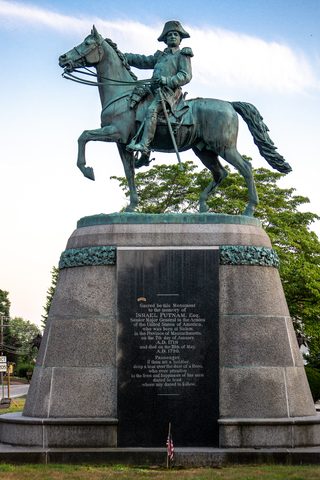

Kingston upon Thames, London: the Coronation Stone, Clattern Bridge, the Tudor conduits and Chessington
Kingston upon Thames, England
Pictures from Kingston upon Thames
See all 1 photos →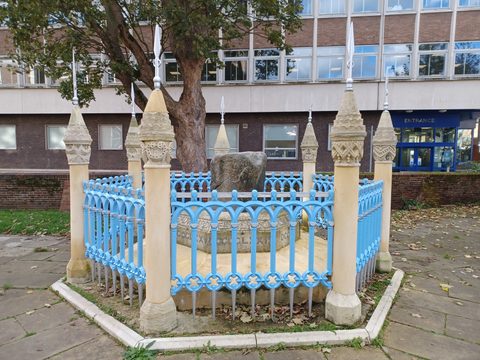
Kingston upon Thames is an outer London borough on the south bank of the river, and it reads as four places rather than one. The town centre keeps a market square trading under a royal charter of 1208, a Saxon coronation site outside the Guildhall, and a museum built with Carnegie money in 1904. The riverside runs from a bridge of about 1175 over the Hogsmill to a public garden of 1890 at Canbury. Surbiton is the railway suburb Kingston got after refusing the main line in the 1830s, with a Southern Railway station of 1937 and a row of Thames-side filter beds that settled an argument about cholera. Coombe, the Maldens and Chessington hold three Tudor conduit houses, a sculptor's studio house of 1936 and a theme park of 128 acres. The National Heritage List for England records 162 listed-building entries in the borough: 3 at Grade I, 13 at Grade II* and 146 at Grade II.
-
sight
A sarsen block outside the Guildhall on the High Street, listed Grade I as NHLE 1080066, held to be the coronation site of seven Anglo-Saxon kings.
-
sight
Begun in 1120 on the Saxon minster site, listed Grade I as NHLE 1358437, with twelve bells, an eighteenth-century carillon and a central tower over a four-bay nave.
-
Trading daily under a charter of 1208 for fish, flowers, jewellery and food, around a Market House of 1838-40 listed Grade II* as NHLE 1358428.
-
walk
Built around 1175 over the Hogsmill and still carrying High Street traffic; scheduled as NHLE 1002021 and listed Grade I as NHLE 1080064.
-
Edward Lapidge's five elliptical arches in Portland stone, opened 17 July 1828 and listed Grade II* as NHLE 1300232; the centre arch spans 60 feet.
-
sight
Free, Thursday to Saturday 10am to 5pm, in a Carnegie building of 1904 listed Grade II as NHLE 1080102; over 2,000 Muybridge lantern slides and 67 zoopraxiscope discs.
-
tip
A producing house on the High Street, opened 16 January 2008, with 822 seats wrapped around a shallow thrust stage and stalls seating in the pit.
-
sight
A seventeenth-century range on Old London Road, listed Grade II* as NHLE 1184584, seen from the street; its founder died in 1667.
-
walk
Fourteen and a half acres of riverside opened in 1890, with an 1891 bandstand, a rowing club and a towpath café facing Steven's Eyot.
-
sight
James Robb Scott's Southern Railway rebuild of 1937, listed Grade II as NHLE 1185071, with a concrete-framed booking hall, clock tower and curved canopy.
-
Eight Grade II entries within 111 m on the Portsmouth Road, among them NHLE 1253334, above the beds that gave John Snow his cholera comparison.
-
walk
A Victorian riverside walk on the old Portsmouth turnpike, running straight into the Seething Wells frontage; the K3 stops within 400 m of the filter beds.
-
tour
Free entry, 11am to 2pm, on five dated 2026 weekends running from 27 June to 25 October, at a Tudor conduit house scheduled as NHLE 1002015 that supplied Hampton Court Palace.
-
tour
Dora Gordine's studio house of 1936, listed Grade II as NHLE 1300092, free Thursday to Saturday 11am to 5pm with last entry at 4.30pm.
-
Flint chancel against a brick nave and tower of 1611, listed Grade II as NHLE 1184102, founded from the endowment that became Merton College, Oxford.
-
128 acres, over 40 rides and a zoo of more than 1,000 animals; the theme park runs February to December, and the 465 bus is the direct link from Kingston.
-
Oak and hazel woodland of 3.5 hectares off Filby Road, over earthworks of a probable medieval hunting lodge scheduled as NHLE 1002018.
-
food
171 High Street, New Malden. The operator's own picture captions describe meats set on the table for grilling and marinated cuts on the grill.
Kingston town centre
Five of the things worth stopping for in Kingston stand inside the old town, and forty-nine listed entries inside the borough fall within 500 m of the Market House; a further fifteen within that radius are across the Thames in Richmond upon Thames.
Kingston Market Place has held a market under the royal charter of 1208, formally established in 1242, with a Wednesday market added in 1662 alongside the existing Saturday one. It still trades daily in the square, KT1 1JS, selling fish, flowers, jewellery, and local and imported food. The Market House stands at the centre, built between 1838 and 1840 to a design by Charles Henman Senior and listed Grade II as NHLE 1358428 — one of the thirteen Grade II entries in the borough. A statue of Queen Anne of 1706 stands on the balcony of its southern facade and was re-gilded in 1995. Grade II frontages ring the square: 6-9 Market Place, NHLE 1358429; 14 Market Place, NHLE 1080079; 15 and 16 Market Place, NHLE 1184764; 23 Market Place, NHLE 1358430; 24 and 24A Market Place, NHLE 1299945; and 30 Market Place, NHLE 1080080. The square lies in the Kingston Old Town Conservation Area.
All Saints Church stands on the Market Place, KT1 1JP, and was listed Grade I on 30 July 1951 as NHLE 1358437. Building began in 1120 under Henry I on the site of the Saxon minster where the Kingston coronations took place, and King Egbert held a great council here in 838. The church is cruciform, with a central tower, a four-bay nave and a clerestory, mixing Norman, Decorated and Perpendicular Gothic work, built of flint with stone dressings and stone battlemented parapets, and it has twelve bells and an eighteenth-century carillon. The pair of gate piers at the churchyard entrance carries its own Grade II entry, NHLE 1184174, and the memorial gates outside are separately Grade II, NHLE 1432596. The chapel of St Mary stood beside the church until 1730, when its walls fell and killed the sexton. It is a working parish church and no source states its visitor opening hours, so none are given here.
The Coronation Stone was recovered from those ruins. It is a block of sarsen, the stone used at Stonehenge, held to be the site of the coronation of seven Anglo-Saxon kings; three of the seven are firmly attested — Aethelstan in 925, Eadred in 946 and Aethelred the Unready in 979 — while Edward the Elder, Edmund I, Eadwig and Edward the Martyr rest on weaker evidence. It was set on a plinth in the market square in 1850 with the seven kings' names inscribed around the side, and was later moved to its present position in front of the Guildhall on the High Street, KT1 1EU, where low railings protect it. It is listed Grade I as NHLE 1080066. Of the three Grade I entries in the borough, this and Clattern Bridge are structures and All Saints is the building. Kingston's standing as a royal borough rests on the coronation tradition, and George V confirmed it in 1927.
Kingston Museum is on Wheatfield Way, KT1 2PS, and opens Thursday, Friday and Saturday 10am to 5pm, closing Sunday to Wednesday. Admission is free. It was built in 1904 with money from Andrew Carnegie and listed Grade II as NHLE 1080102 under the name Kingston Public Library, Museum and Art Gallery, and it still adjoins the library. It holds the principal collection on Eadweard Muybridge, who was born in Kingston: over 2,000 glass magic lantern slides and 67 glass zoopraxiscope discs, together with equipment from his public lectures in the United States and Europe in the 1880s and 1890s. It also holds 120 pieces of Martinware ceramics and the Brill Collection of more than 110 topographical artworks, and three permanent displays cover the borough's ancient origins, its medieval-to-1940s development under the title 'Town of Kings', and Muybridge. A stone from King John's Palace stands in the courtyard of the public library and carries its own Grade II listing, NHLE 1358458. The co-located History Centre closes between 1pm and 2pm and is by appointment.
Cleave's Almshouses are a seventeenth-century range on Old London Road, KT2 6QA, listed Grade II as NHLE 1184584 — another of the borough's thirteen Grade II entries. Their founder, William Cleave, died in 1667 and is commemorated by a monument in All Saints. The building is seen from the street and its garden, and no visitor opening hours are published, so none are given here. It stands in a dense group: 43-47 Old London Road, NHLE 1080073, is Grade II and 42 m away, and 30 Old London Road, NHLE 1080075, is Grade II and 89 m away. The former Bentalls Depository, Grade II, NHLE 1253306, is 124 m off, so the medieval-to-Victorian street survives directly behind the modern leisure complex.
The riverside: Clattern Bridge to Canbury
The Hogsmill River joins the Thames at the foot of the town, and the walk from that confluence north to Canbury takes in two river crossings some six hundred and fifty years apart, a producing theatre and a Victorian public garden.
Clattern Bridge carries the High Street, KT1 1HD, over the Hogsmill a few metres above its confluence with the Thames. It was built around 1175, replacing an earlier Saxon crossing, and it still takes full modern vehicle traffic. The lower courses are three arches of dressed ashlar with flint rubble filling, the original twelfth-century fabric; it was widened in 1758 in red brick with stone-capped parapets and again in 1852 with further brickwork and ornamental iron railings. The name descends through Clatrung Bridge and Clateryngbrugge, thought to record the clatter of hooves crossing it. It was scheduled as a monument on 16 February 1938, NHLE 1002021, and is separately listed Grade I, NHLE 1080064; a scheduled monument carries no grade, which is why the bridge appears twice on the register. It is one of the six scheduled monuments in the borough.
Kingston Bridge, KT1 1QN, opened on 17 July 1828 to a design by the county surveyor Edward Lapidge, in Portland stone, with five elliptical arches and a centre arch spanning 60 feet. The Earl of Liverpool laid the first stone on 7 November 1825 and the Duchess of Clarence opened the bridge. It replaced a medieval timber bridge that had become dangerously dilapidated; until Putney Bridge opened in 1729, the crossing here was the next one upstream from London Bridge. Mott & Hay widened the carriageway from 25 feet to 55 feet in 1912-14, reopening in October 1914, and a second widening in 2000 took it to 79 feet, adding cycle lanes, wider pavements and a bus lane. It carries the A308 and the Thames Path, and it is listed Grade II*, NHLE 1300232. Hampton Wick station, at the far end of the bridge, is in Richmond upon Thames.
The Rose Theatre is at 24-26 High Street, KT1 1HL, on the stretch of the High Street between the Guildhall and Clattern Bridge. It opened on 16 January 2008 with an 822-seat auditorium, its plan modelled on the Elizabethan Rose Theatre on Bankside in Southwark, with the seating wrapped around a shallow thrust stage and stalls seating in the pit. It works as a producing house rather than a receiving house, staging its own drama alongside comedy and an education programme.
Canbury Gardens run for 14.5 acres between Lower Ham Road, KT2 5AW, and the Thames towpath. The borough surveyor Henry Macaulay designed them and they opened in 1890; the bandstand, erected in 1891 and paid for by a former mayor, Charles Nuthall, still stands. Kingston Rowing Club is on the site and a café works out of a converted toilet block. The Thames Path runs along the river frontage, which faces Steven's Eyot. The gardens lie in the Riverside North Conservation Area, designated in November 2004 over 27 hectares and 62 properties, and the council's designation summary names 'important 19th century public works that established Canbury Gardens' among the area's special interest. No listed entry inside the borough stands within 400 m; the two entries within that radius are across the Thames in Richmond upon Thames, the Grade II* Normansfield (Velma) Boathouse, NHLE 1418051, and the Grade II The Grove, NHLE 1065387. This is a place designated as townscape rather than as fabric.
Surbiton, Seething Wells and the Portsmouth Road
Kingston refused the main line in the 1830s, so the London and South Western Railway routed it through open country to the south, and the town of Surbiton grew around the station that resulted. The Portsmouth Road then runs west from the station towards the river, and everything else in this part of the borough sits along it.
Surbiton Station, Victoria Road, KT6 4PE, was rebuilt in 1937 by the Southern Railway to a design by James Robb Scott in an Art Deco idiom, with a concrete-framed booking hall, a clock tower and a curved canopy. It was listed Grade II on 6 October 1983 as NHLE 1185071 and remains an operational station, run by South Western Railway, in London fare zone 6. Thirteen bus routes stop within 400 m of it: 71, 281, 406, 418, 465, 662, 665, 671, K1, K2, K3, K4 and N65.
Seething Wells, KT6 5PJ, is a Thames-side strip of Victorian public-health engineering. Two rival companies built here: the Lambeth Waterworks Company began in 1847 and opened in 1852, and the Chelsea Waterworks Company began in 1854 and opened in 1856. Moving the Lambeth intake upriver to Seething Wells gave John Snow his natural experiment — houses supplied from here had a cholera mortality rate fourteen times lower than houses supplied by the Southwark and Vauxhall company downriver. Both companies later moved their intakes again, to Molesey, because turbulence at the river bends drew too much mud. Thames Water largely decommissioned the works in 1992, and seven decommissioned filter beds roughly 8 m deep survive as the main original infrastructure. Six Grade II entries cover the buildings: the former Chelsea Waterworks Office/Lodge (Building No. 11), NHLE 1253334; the former Chelsea Waterworks Coal Store (Building No 12), NHLE 1080060; the former Chelsea Waterworks Fountain (Building No. 13), NHLE 1261819; the former Lambeth Waterworks uncovered coalstore including tower and attached tunnels, NHLE 1031864; the former Lambeth Waterworks District Offices and Stores Building, NHLE 1390654; and the former Lambeth Waterworks Muniments Building, NHLE 1390655. Two further Grade II entries cover only the boundary railings and walls, NHLE 1253376 and NHLE 1253378, and the eight entries stand within 111 m of one another, measured between the two furthest apart. Some of the surviving buildings are now Kingston University's Seething Wells halls of residence; the filter beds are not open as a visitor site and are seen from the Portsmouth Road frontage and the towpath.
Queen's Promenade, KT6 4AJ, is the Victorian riverside walk laid out along the Portsmouth Road, the former turnpike between London and Portsmouth; a map of 1762 shows the road here as entirely rural. The promenade runs continuously into the Seething Wells frontage, so the walk and the filter beds are one. Both lie in the Riverside South Conservation Area, designated in February 2003 over 22.8 hectares and 240 properties, which the council describes as 'a linear area forming the setting to Hampton Court Park, along the Portsmouth Road and the River Thames' and whose special interest includes the strategic views into Hampton Court Palace's parkland from the riverside path. This bank is the Kingston side of that setting; the palace and its registered park and garden, NHLE 1000108, are in Richmond upon Thames. At the filter beds, 850 m west along the Portsmouth Road from Surbiton station, the K3 is the bus route that stops within 400 m.
Coombe, the Maldens and Chessington
Coombe is wooded high ground of large villas and private roads, and it holds the Tudor waterworks that is the borough's genuine thread. New Malden adjoins it directly, and the suburbs run south from there into Surrey countryside at Chessington.
Coombe Conduit, Coombe Lane West, KT2 7HG, is a Tudor spring-water collection house that gathered water from the Coombe springs and piped it under the Thames to Hampton Court Palace. It is a scheduled monument, NHLE 1002015, and its conduit house is listed Grade II, NHLE 1080099. Two more conduits of the same system survive in Coombe and are separately designated: Gallows Conduit is a scheduled monument, NHLE 1002016, with its conduit house Grade II, NHLE 1080062, and Ivy Conduit is a scheduled monument, NHLE 1005554, with its conduit house Grade II, NHLE 1080063. A brick reservoir 270 m south-west of Gallows Conduit is a fourth scheduled monument of the system, NHLE 1002041, so four of the borough's six scheduled monuments are parts of one Tudor waterworks. The system ran for roughly 350 years and delivered water until 1876, though the supply had become intermittent before then. English Heritage looks after Coombe Conduit with the Coombe Conduit Association and entry is free; the standing strapline reads 'Open fourth weekend of the month, Apr - Oct', 11am to 2pm, and the dated 2026 season begins in June, on 27 and 28 June, 25 and 26 July, 22 and 23 August, 26 and 27 September, and 24 and 25 October. The site is otherwise closed and cannot be visited outside those weekends.
Dorich House Museum stands at 67 Kingston Vale, SW15 3RN — an SW15 postal district that faces Wandsworth, on a building inside the Royal Borough of Kingston upon Thames. The sculptor Dora Gordine designed it for herself and completed it in 1936 as a combined studio, gallery and home, and the operator describes it as an exceptional example of a modern studio house by a woman artist. It is listed Grade II, NHLE 1300092, opens Thursdays, Fridays and Saturdays 11am to 5pm with last entry at 4.30pm, and admission is free. It holds sculpture by Gordine together with the Russian art collection of her husband, Richard Hare, and Kingston University owns and runs it. It stands outside the south-western wall of Richmond Park; the park is in Richmond upon Thames, while the Grade II park boundary walls on Kingston Hill, NHLE 1080049 and NHLE 1358450, and the two bollards at Ladderstile Ride, NHLE 1358461, are in Kingston, because the borough line runs along the wall.
Old Malden is the older village at the south of the borough. The Church of St John the Baptist, Church Road, Worcester Park KT4 7RY, was built by Walter de Merton, Bishop of Rochester, who founded a college at Malden in 1264 that later moved to Oxford and became Merton College. In 1611 the old flint walls of the chancel were repaired and the nave and tower rebuilt in brick, so the church reads as flint chancel against Jacobean brick; it was restored in 1863, extended in 1875 and extended again in 2004. It is listed Grade II, NHLE 1184102. The Manor House beside it is separately Grade II, NHLE 1358435, and the manor appears in Domesday Book; the fifteenth-century Plough Inn at the centre of Plough Green is Grade II, NHLE 1080094; and Old Malden War Memorial outside the church is Grade II, NHLE 1444327. The church, the manor house and Plough Green together form the Old Malden (St John's and Plough Green) Conservation Area.
Chessington is 9 km from the Market Place, with no direct rail between them. Chessington World of Adventures Resort, Leatherhead Road, KT9 2NE, opened as a zoo in 1931 and reopened as a theme park on 7 July 1987. It covers 128 acres (52 hectares) and holds over 40 rides, a zoo of more than 1,000 animals, a Sea Life centre, two on-site hotels and a spa. Merlin Entertainments owns it, acquired through the merger with the Tussauds Group in 2007, and the park received about 1.5 million visitors in 2022. The theme park operates February to December, with the fullest offering March to November, while the zoo and the hotels open year round. Burnt Stub, the mansion at the heart of the site, predates the park and now houses a park attraction, and a milestone west of the road beside the car park is listed Grade II, NHLE 1080072.
Castle Hill, Chessington, entered from Filby Road, KT9 2AG, is a wooded local nature reserve of 3.5 hectares (8.6 acres) and a Site of Borough Importance for Nature Conservation, Grade 1. The earthworks in it probably mark a medieval hunting lodge and are a scheduled monument, NHLE 1002018, covering 2.55 hectares, a smaller extent than the reserve. The woodland is mainly oak and hazel, with bluebells and wood anemones in the ground flora and breeding jays and woodpeckers. Merton College, Oxford owns the land, Kingston Council leases it and the Lower Mole Countryside Management Project manages it; Merton College's ownership here and Walter de Merton's foundation at Old Malden are two survivals of the same medieval endowment inside one borough.
Getting there
The Royal Borough of Kingston upon Thames has no London Underground station, no London Overground station, no DLR station, no Elizabeth line station and no tram stop. All ten rail stations inside the borough are National Rail and South Western Railway runs every one of them: Kingston, Norbiton, Surbiton, Berrylands, New Malden, Malden Manor, Worcester Park, Tolworth, Chessington North and Chessington South. Kingston refused the main line in the 1830s and the network still shows it. Richmond, in Richmond upon Thames and 5.91 km from the Market House, is the only Underground or Overground interchange within 6 km of the town centre, taking the District line, the Mildmay line and South Western Railway; Wimbledon is 7.05 km away, Kew Gardens 7.58 km, Wimbledon Park 7.89 km, Southfields 7.94 km and Putney Bridge 9.36 km. The bus network does the work instead, including the borough's own K-prefixed routes — K1, K2, K3, K4 and K5 — and the SL7 Superloop express.
For the town centre and the riverside, take South Western Railway to Kingston, about 480 m north-east of the Market House; trains run to London Waterloo both ways round the Kingston loop, via Wimbledon and via Richmond. Norbiton is the nearest station to Old London Road and Cleave's Almshouses, and Hampton Wick, at the far end of Kingston Bridge, is in Richmond upon Thames. Twenty-five bus routes serve stops within 350 m of the Market Place: 57, 65, 71, 85, K1, K2, K3, K4, K5, 111, 131, 213, 216, 281, 285, 371, 406, 411, 418, 465, 481, 671, N65, N87 and SL7.
For Surbiton, Seething Wells and the Portsmouth Road, take South Western Railway to Surbiton — the 1937 building, NHLE 1185071, is the place itself — with Berrylands the other station in the area. Thirteen routes stop within 400 m of Surbiton station, but at the filter beds, 850 m west along the Portsmouth Road, only the K3 does. Walk the Queen's Promenade from Surbiton, or take the K3.
For Coombe, Kingston Hill and Kingston Vale, Norbiton is the nearest station and New Malden serves the south side of Coombe; there is no station in Coombe or Kingston Vale at all, so Dorich House and the conduits are bus or walking approaches. The 85, the K3 and the 265 serve the area, and the 85 and the K3 run along Kingston Hill for the Richmond Park gates.
For the Maldens and Chessington, New Malden, Malden Manor and Worcester Park are on the lines out of Waterloo: Worcester Park is about 25 minutes from London Waterloo, and Malden Manor, on the Chessington branch, is the nearest station to Old Malden church, with Worcester Park. Chessington South is the terminus of that branch and the station for the theme park, with Chessington North before it. Ten routes serve New Malden — K1, K5, 131, 152, 213, 265, 662, 665, N87 and SL7 — and three serve Chessington: the 71, the 465 and the N65. There is no direct rail service between Kingston town centre and Chessington, because the Kingston loop and the Chessington branch are different lines out of Waterloo; the 465 bus is the direct link.
Frequently asked questions
- Does Kingston upon Thames have an Underground station?
- No. The borough has no London Underground station, no London Overground station, no DLR station, no Elizabeth line station and no tram stop. All ten rail stations inside it are National Rail and South Western Railway runs every one: Kingston, Norbiton, Surbiton, Berrylands, New Malden, Malden Manor, Worcester Park, Tolworth, Chessington North and Chessington South. Richmond, 5.91 km from the Market House and in Richmond upon Thames, is the nearest Underground or Overground interchange, taking the District line and the Mildmay line as well as South Western Railway. Kingston travels by bus instead, including the K1 to K5 local network and the SL7 Superloop express.
- When can I get inside Coombe Conduit?
- Coombe Conduit, Coombe Lane West, KT2 7HG, is looked after by English Heritage with the Coombe Conduit Association, and entry is free. English Heritage publishes a standing strapline of 'Open fourth weekend of the month, Apr - Oct', 11am to 2pm, and a dated 2026 season that begins in June: 27 and 28 June, 25 and 26 July, 22 and 23 August, 26 and 27 September, and 24 and 25 October. The site is otherwise closed and cannot be visited outside those weekends. It is a scheduled monument, NHLE 1002015, and its conduit house is listed Grade II*, NHLE 1080099; the Tudor system piped spring water under the Thames to Hampton Court Palace.
- How many listed buildings does Kingston hold?
- The National Heritage List for England records 162 listed-building entries inside the borough: 3 at Grade I, 13 at Grade II* and 146 at Grade II. The three Grade I entries are the Church of All Saints, NHLE 1358437; Clattern Bridge, NHLE 1080064; and the Coronation Stone, NHLE 1080066 — of those, one is a building and two are structures. The borough also holds six scheduled monuments: Coombe Conduit, NHLE 1002015; Gallows Conduit, NHLE 1002016; the Castle Hill earthwork at Chessington, NHLE 1002018; Clattern Bridge, NHLE 1002021; the brick reservoir south-west of Gallows Conduit, NHLE 1002041; and Ivy Conduit, NHLE 1005554. It holds no registered park or garden, no battlefield, no protected wreck site and no World Heritage Site.
- Are Hampton Court Palace and Richmond Park in Kingston?
- No. Hampton Court's registered park and garden, NHLE 1000108, and Richmond Park's registered landscape, NHLE 1000828, are both in Richmond upon Thames: Hampton Court has no area inside Kingston at all, and of Richmond Park's 954 hectares just 0.3 fall on the Kingston side of the wall, so the borough holds no registered park or garden. What Kingston has is the approach and the setting: the three Tudor conduit houses in Coombe that piped spring water under the Thames to the palace, four of the borough's six scheduled monuments; the Riverside South Conservation Area, which the council describes as 'a linear area forming the setting to Hampton Court Park, along the Portsmouth Road and the River Thames'; and the Grade II Richmond Park boundary walls on Kingston Hill, NHLE 1080049 and NHLE 1358450, with the two bollards at Ladderstile Ride, NHLE 1358461, which are in Kingston because the borough line runs along the park wall.
- Which museums are open, and what do they cost?
- Kingston Museum, Wheatfield Way, KT1 2PS, opens Thursday, Friday and Saturday 10am to 5pm and closes Sunday to Wednesday; admission is free. It holds the principal collection on Eadweard Muybridge, who was born in Kingston, including over 2,000 glass magic lantern slides and 67 glass zoopraxiscope discs, and it is listed Grade II, NHLE 1080102. Dorich House Museum, 67 Kingston Vale, SW15 3RN, opens Thursdays, Fridays and Saturdays 11am to 5pm with last entry at 4.30pm, and admission is free; Kingston University owns and runs Dora Gordine's studio house of 1936, NHLE 1300092. The Kingston History Centre, co-located with the museum, closes between 1pm and 2pm and is by appointment.
- What is there to do at Chessington?
- Chessington World of Adventures Resort, Leatherhead Road, KT9 2NE, opened as a zoo in 1931 and as a theme park on 7 July 1987. It covers 128 acres (52 hectares) and holds over 40 rides, a zoo of more than 1,000 animals, a Sea Life centre, two on-site hotels and a spa; the theme park runs February to December and the zoo and hotels year round. Chessington South, on South Western Railway, is the station for it, and the 465 bus is the direct link from Kingston town centre, because the Kingston loop and the Chessington branch are different lines out of Waterloo. Castle Hill, Chessington, off Filby Road, KT9 2AG, is a 3.5-hectare local nature reserve whose earthworks are a scheduled monument, NHLE 1002018.
Connected pages
Nearby
-
Merton, London: Wimbledon Common and the windmill, the All England Club, Merton Priory and Morden Hall Park
· Merton, England
Kingston has no tube or Overground station: Richmond at 5.91 km and Wimbledon at 7.05 km are the nearest, and Merton is where Kingston's readers change trains.
-
Sutton, London: Carshalton Ponds, Honeywood Museum, Whitehall in Cheam, Carew Manor and Little Holland House
· Sutton, England
The Surrey edge: Nonsuch Park straddles Sutton's boundary and Ewell's old church tower sits outside Kingston's, one chalk-country fringe where London stops.
Shared history
-
Richmond upon Thames, London: Kew, Richmond Park, Hampton Court Palace, Ham House and Strawberry Hill
· Richmond upon Thames, England
Kingston's Tudor conduit houses at Coombe piped spring water under the Thames to Hampton Court; the palace and Richmond Park are both in Richmond upon Thames.
Same region
-
Korean BBQ in London: the West End, Paddington, Clerkenwell, and the boroughs south and east
· London Korean BBQ, England
Imone BBQ is at 171 High Street, New Malden, in the Royal Borough of Kingston upon Thames.
What travelers think
Log in to react.
No reviews yet.